Choosing flowers
Bouquet, vase arrangement or flower box: what should you send?
Choose the gift that fits the recipient’s space and daily routine, not just the product photograph. Compare what arrives, what needs watering and what the recipient must do next.
On this page
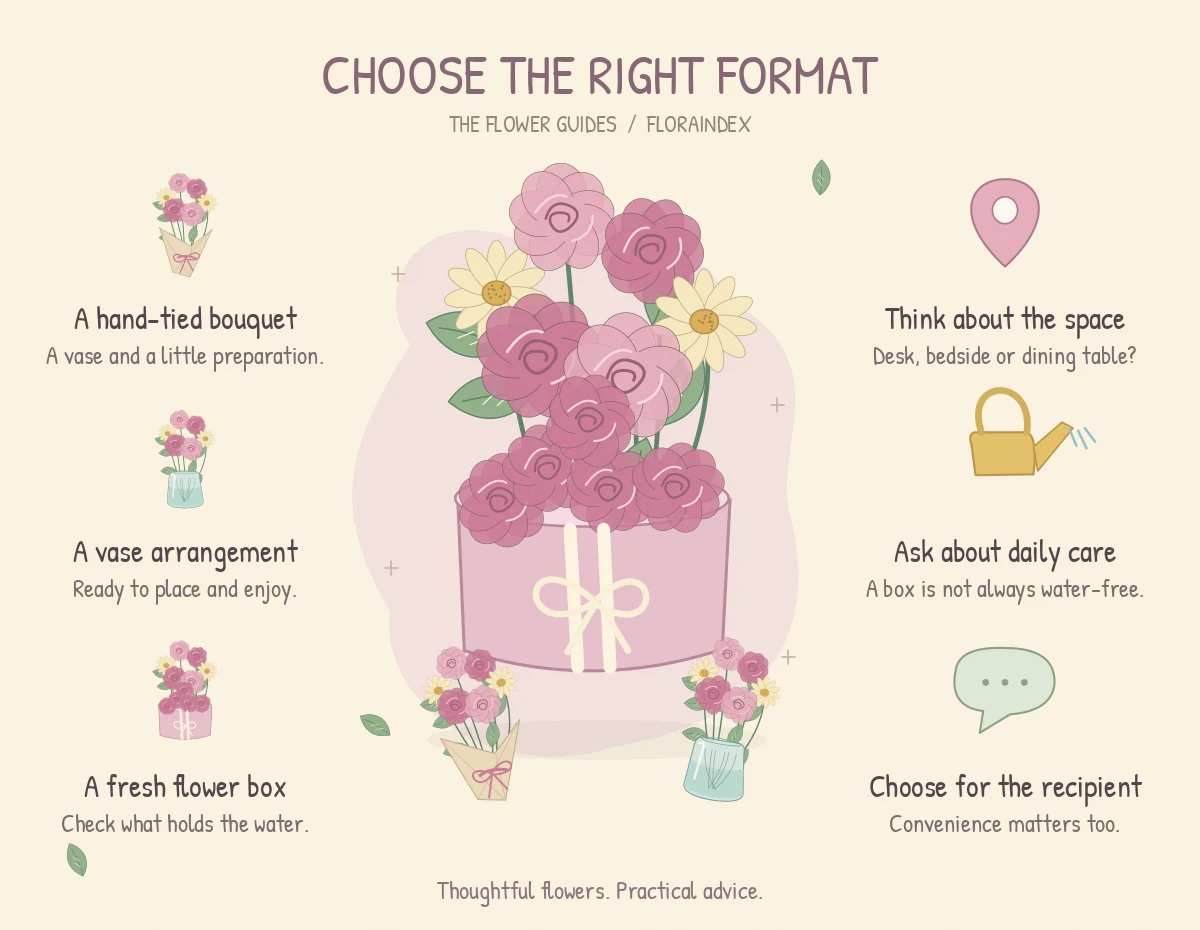
A bouquet can be a lovely gift and an awkward arrival. Someone has to find a vase, clear a space, remove the wrapping and deal with the stems. A vase arrangement takes away much of that first job, while a flower box may hide either a convenient water supply or care instructions the recipient was not expecting.
Choose the format around what happens after the doorbell rings. For a recipient who enjoys arranging flowers, a bouquet gives freedom. For someone who needs the gift ready to display, a suitable container arrangement is usually the more practical starting point. A box is worth choosing for its design only after you know what is inside it.
Compare the three formats
| Format | Useful when | Check before ordering |
|---|---|---|
| Wrapped or hand-tied bouquet | The recipient has a vase and enjoys handling flowers. | Whether a vase is included, and how the stems are hydrated for delivery. |
| Fresh vase arrangement | The recipient wants flowers ready to put in place. | The actual vase, filled size, weight and access for adding water. |
| Fresh flower box | A compact, structured design suits the available space. | Whether it contains floral foam or a water reservoir, and how to refill it. |
| Preserved flower box | The recipient wants a decorative keepsake rather than fresh cut flowers. | That it is clearly described as preserved, with product-specific care instructions. |
These are useful distinctions, not fixed industry definitions. One florist's bouquet may arrive with a vase; another's “boxed flowers” may be loose stems in a shipping carton. Look at the contents of the order, not just the category name.
Send a bouquet when arranging is part of the pleasure
A bouquet is a good choice for someone who likes choosing a vase, shortening stems and deciding where each flower belongs. It can be divided into small arrangements around the house, or kept together in its original hand-tied shape. That flexibility matters more than whether the gift looks elaborate in its wrapping.
The recipient needs more than an empty corner on a table. Think about access to a sink, a suitable vase and a clean cutting tool. A generous bunch may overwhelm the narrow vase they already own; long stems may need a taller, heavier container than expected.
A water bag is transport packaging. If the florist offers an aqua-packed bouquet, ask whether the bag is only for delivery or is intended to remain temporarily. Do not describe it to the recipient as a permanent, maintenance-free vase. The supplied instructions should explain how to transfer the flowers and handle the water without a spill.
A hand-tied bouquet has already been arranged, so “bouquet” does not necessarily mean a pile of loose stems that must be designed from scratch. It still needs an appropriate water supply and ongoing care. Ask the florist whether the recipient can leave the structural tie in place when putting it in a vase.
If you are bringing flowers to a meal, consider the host's next few minutes. A wrapped bunch gives them a job just as guests arrive. Bringing a suitable vase, choosing a ready-arranged option, or arranging delivery at a quieter time can be more helpful than increasing the bouquet's size.
Send a vase arrangement to reduce the initial work
A vase arrangement is especially useful when you do not know what containers the recipient owns. It can also suit someone who would find trimming stems, finding equipment or arranging flowers difficult. Ask for genuinely ready-to-display flowers, rather than a bouquet and an empty vase packed separately.
Ready to display, not care-free. Fresh flowers still need their water checked. A clear vase makes the level easier to see, while an opaque container may suit the room but hide when the supply is running low. Neither is automatically better; accessibility and the recipient's preferences decide.
Ask whether stems sit freely in water or are secured by a tape grid, flower holder, wire or foam. University extension guidance distinguishes these constructions because fixed arrangements should not be pulled apart for routine water changes. A broad opening that is easy to refill may be more useful than an unusual narrow-necked vessel.
Check the filled dimensions, not just the vase height. Flowers can spread well beyond the container. A low design may work better on a dining table or desk where people need to see across it, while an upright arrangement may suit a side table with room above it.
The container is also an object the recipient keeps. Choose something they are likely to reuse, or ask whether a simple vessel is available. If lifting a filled vase could be difficult, discuss a smaller arrangement and how it can be watered in place. Do not assume “ready-made” means lightweight.
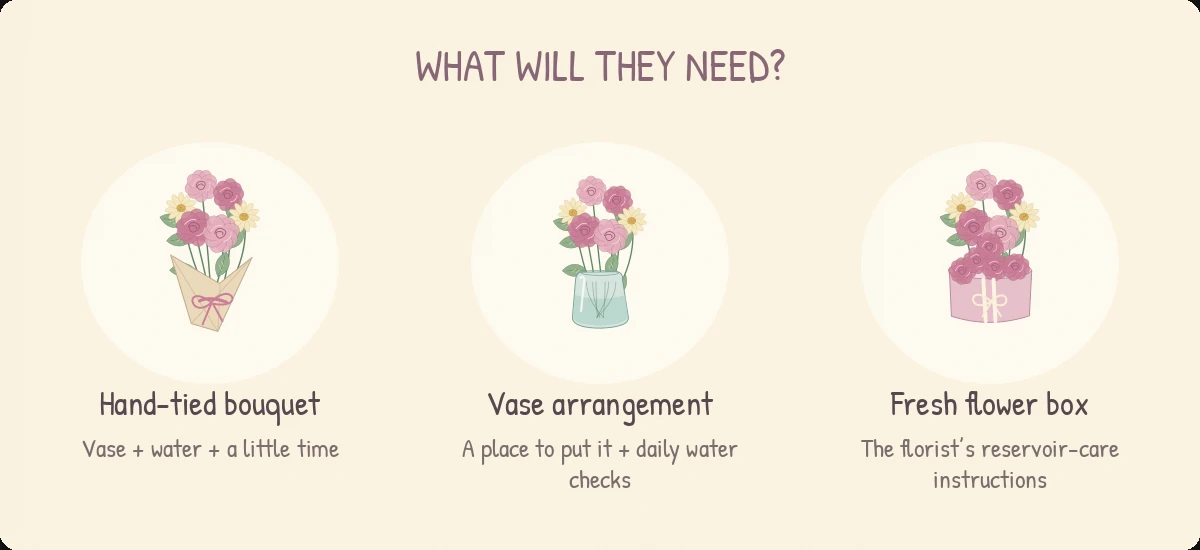
Before choosing a flower box, ask what is inside
A hatbox-style arrangement may look self-contained, but its outer walls are not necessarily the part that holds water. Fresh stems may be set into wet floral foam inside a liner, or supported above a hidden water-filled vessel. Another product called a flower box may simply be the packaging around flowers that need transferring to a vase.
A fresh arrangement in floral foam
Foam supports stems and holds water. It allows the florist to place flowers in a structured design, including designs with short stems. The recipient should follow the watering instructions and leave the stems in position rather than repeatedly pulling them out and pushing them back in. The water supply still needs attention.
Ask where water should be added and how the recipient can tell when enough has been poured. A care card that only says “water regularly” is less useful than a clear explanation of the actual construction. The florist should also explain how to protect the decorative box and the furniture underneath it.
A fresh arrangement with a hidden reservoir
A hidden reservoir still needs refilling. Confirm the access point and whether the inner vessel can be removed, or should remain in place. Do not infer that a box is watertight because the flowers appear to be standing upright. Practical instructions are especially important when foliage hides the opening.
A preserved or dried flower box
Preserved flowers are not fresh cut flowers. They began as natural flowers and underwent a preservation treatment. Dried flowers are a different product again, produced through drying. Both can be intentionally chosen decorative gifts, but neither should be substituted silently when you ordered fresh stems.
Do not water preserved flowers. Follow the maker's instructions rather than applying a fresh-bouquet routine. Preserved-flower producer Verdissimo, for example, advises keeping its products indoors, away from direct sun, excessive humidity and heat, and not watering or spraying them. How long an arrangement keeps its appearance depends on the particular product and the conditions where it is displayed; do not assume every preserved box will last the same number of years.
Match the recipient and the delivery
The best format at home may be inconvenient at work. Before sending a large vase to an office, think about whether the recipient must carry it onto a bus or train that evening. A flower box can also be bulky and must not be assumed spill-proof. Ask the florist about the packed dimensions, carrying support and whether the arrangement needs to stay upright.
For someone recovering from illness or dealing with a bereavement, reduce decisions rather than adding them. A modest ready-to-display arrangement may be easier than a large bouquet that needs immediate work. If another person will help with watering, make sure the care instructions are clear enough to pass on.
For hospitals, care homes, hotels and other managed buildings, check the actual receiving rules first. Ask whether flowers are accepted in the relevant room or ward, whether a vase is required, and who can take delivery. Do not assume a format that worked at one venue will be permitted at another.
A surprise should still have a workable handover. Give accurate recipient and access details, and confirm what happens if nobody can receive the delivery. The shape of the gift does not solve the problem of fresh flowers left somewhere unsuitable.
If you are ordering for another country, establish whether a local florist will make the arrangement or whether a parcel will be shipped. Those are different delivery plans. Our guide to sending flowers overseas explains what to check before choosing the product.
Compare what the price includes
Do not assume a bouquet is cheaper than a vase arrangement or a flower box. Stem selection, quantity, season, design work, container and delivery all affect the particular quote. Compare the complete order, including any vase or packaging needed to use the flowers.
Ask for the approximate finished height and width, the flowers that define the design, and the substitution policy. A photograph alone may not show scale or explain which pictured container is included. If stem count matters to you, ask whether it is specified for that product rather than assuming that “large” has a standard meaning.
Tell the florist what you value. “Please prioritise the flowers over an ornate box” is a different brief from “The reusable vase is an important part of the gift.” Either can be reasonable. A format is worth paying for when it adds something the recipient will actually use or enjoy.
You can browse florists and then confirm those details with the business handling the order. For checks beyond the product itself, see how to choose a reliable florist online.
Check pets and care before agreeing to substitutions
Packaging does not make a hazardous plant safe. For a home with cats, ask for no true lilies, Lilium, and no daylilies, Hemerocallis, including substitutions. These can cause severe kidney injury. With Lilium, pollen and water from the arrangement are also exposure risks; a taller vase or closed-looking box is not a solution.
If a cat may have contacted or ingested a lily, its pollen or its vase water, contact a veterinarian or emergency veterinary service immediately, without waiting for symptoms. A lily-free mixed arrangement is not a blanket pet-safety guarantee: other plant ingredients also need checking.
For any fresh format, request readable care instructions that explain its water supply. The recipient should know whether to transfer stems, leave the design intact or add water through a particular opening. Include flower food where appropriate, with its directions. Our cut-flower care guide covers cleaning, water checks and display position.
Think about what remains afterward
If waste matters to you, ask about the actual materials rather than treating “box,” “paper-wrapped” or “reusable” as a complete environmental assessment. A decorative package can contain liners, tape, wire or foam that are not obvious in the photograph. A vase only provides the reuse you want if someone keeps and uses it.
You can ask for a foam-free design or less decorative packaging without claiming that one format is always the lowest-impact choice. Keep conventional floral foam out of garden compost; Iowa State Extension identifies it as non-compostable. Ask how the components should be separated and follow the local disposal rules for each material.
Give the florist a useful brief
You do not need to specify every stem. A few practical details let the florist propose something appropriate. For example: “This is for a small desk, and the recipient will take it home on public transport. Please suggest a compact arrangement and explain how it travels.”
Or: “They enjoy arranging flowers and already have vases. Please focus the order on fresh stems rather than a decorative container, and include clear care instructions.” Add any plant exclusions, colour preferences and the agreed delivery details.
Before paying, confirm the format, what is included and what the recipient needs to do on arrival. The right choice is the one that fits their space, preferences and ability to care for the flowers—not the one with the most impressive packaging.
Further reading
A little more help
Sending flowers
How to choose a reliable florist online
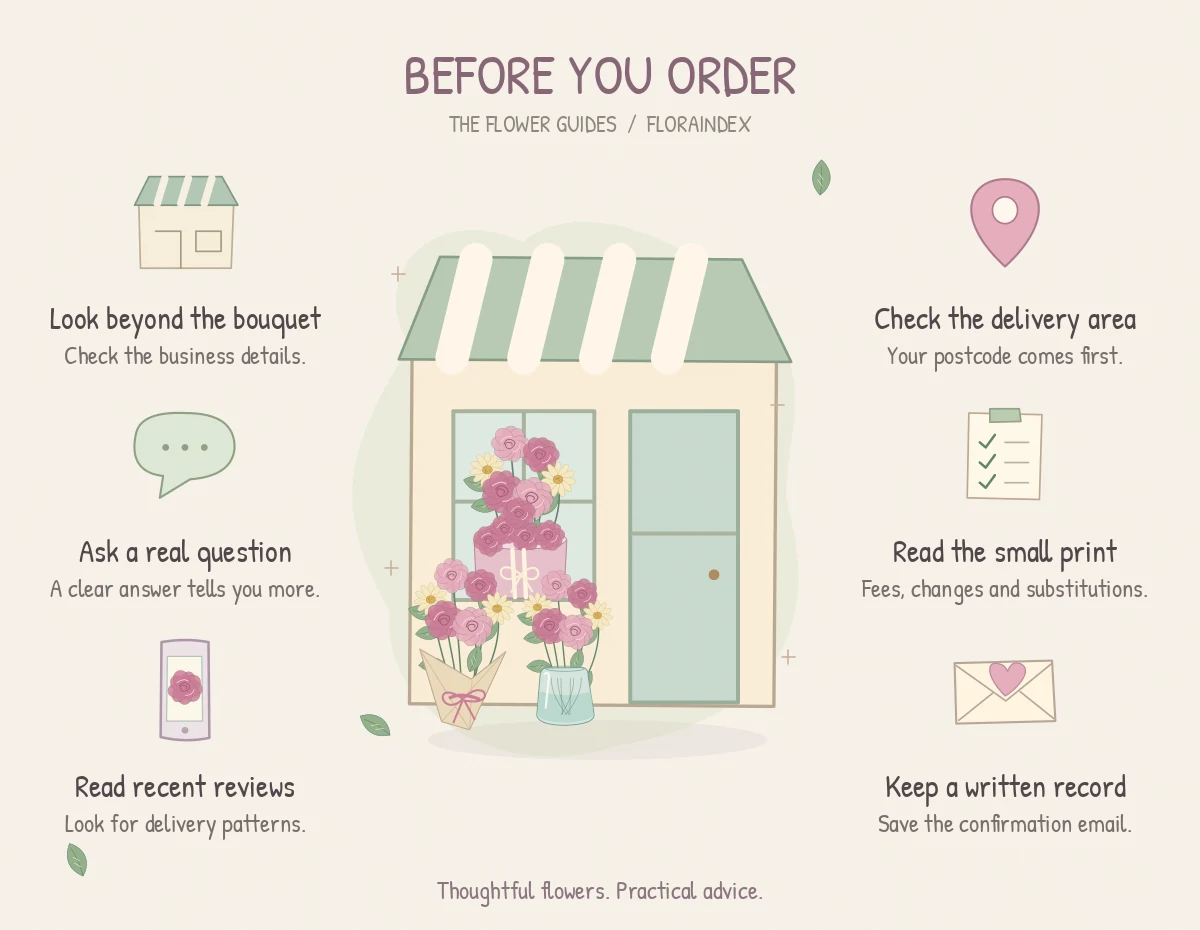
Judge the business behind the bouquet, not just its photographs or star rating. These checks help you compare the actual flowers, delivery promise and support you are buying.
Sending flowers
How to send flowers overseas
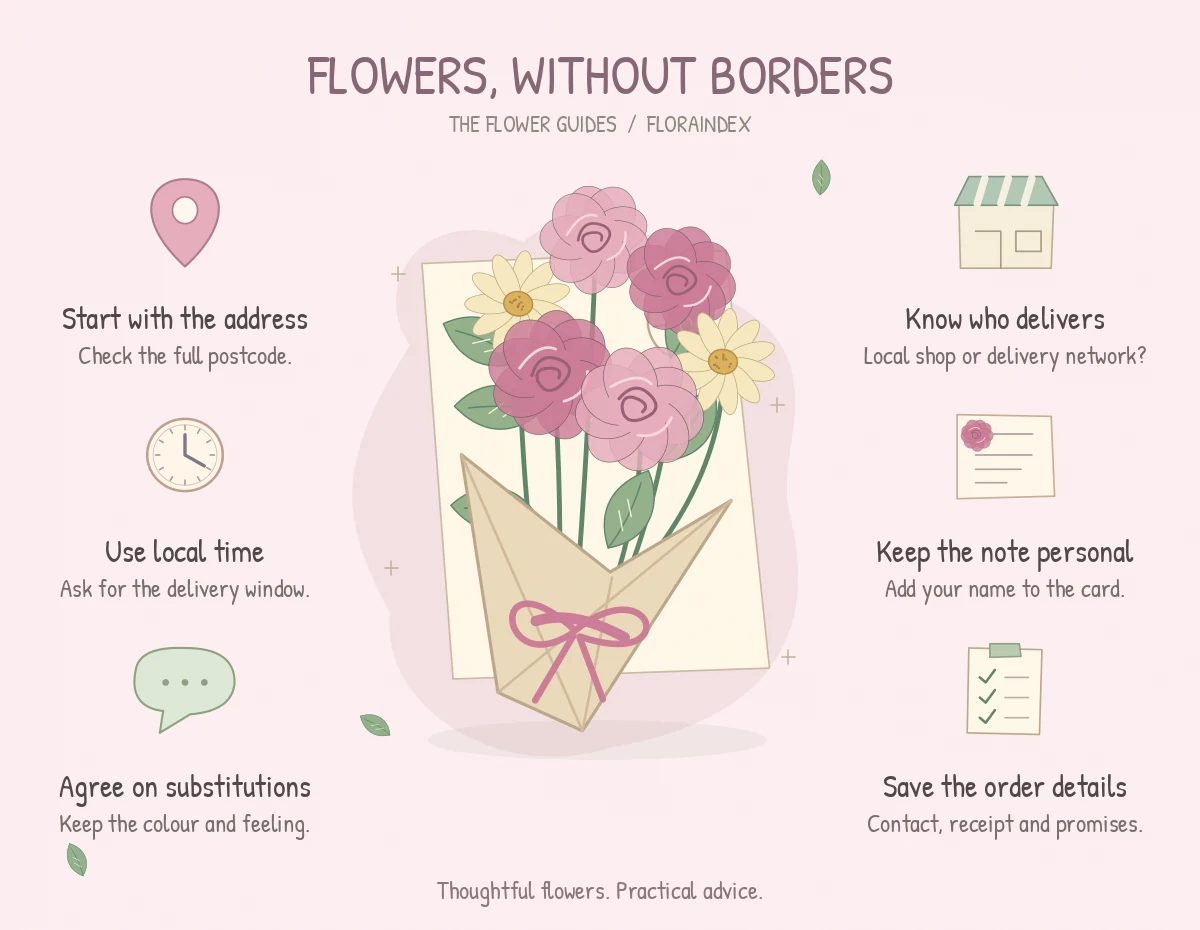
Arrange a flower delivery in another country without confusing local florist fulfillment with international shipping. Plan the date, handover and order details before you pay.