Sending flowers
How to send flowers overseas
Arrange a flower delivery in another country without confusing local florist fulfillment with international shipping. Plan the date, handover and order details before you pay.
On this page
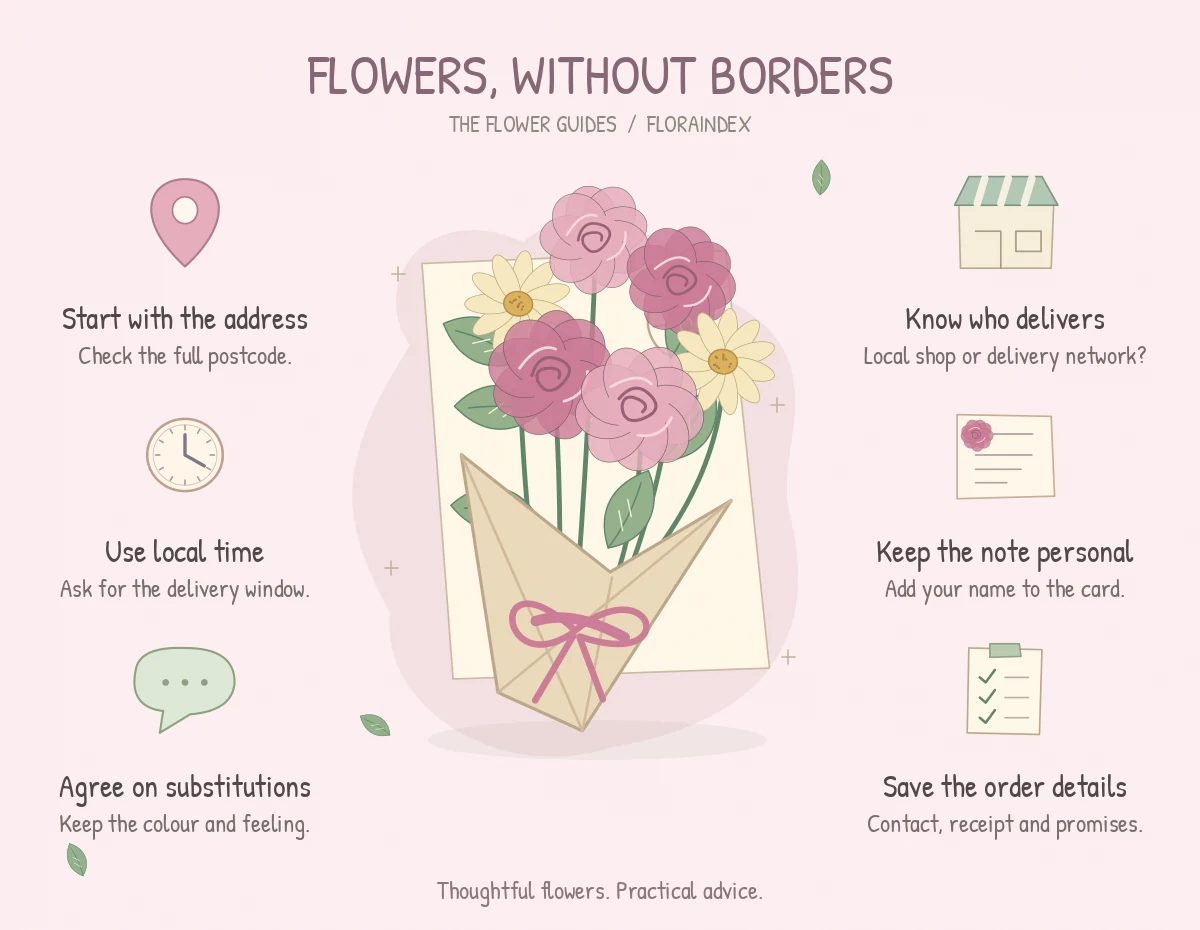
A birthday bouquet for someone abroad is usually an ordering problem, not a packing problem. You need flowers delivered near the recipient, on a useful day, with enough information for the florist to find them. The flowers do not necessarily need to travel from your country at all.
Start with the delivery address and the recipient's local date. Then choose how the order will be filled, settle any substitutions and check the complete price. Those decisions matter more than finding a bouquet that looks exactly like one in a shop at home.
Choose local delivery or international shipping
There are several ways to send flowers overseas, and the distinction affects who prepares the bouquet and who handles a problem.
| Ordering route | What to establish |
|---|---|
| Local florist | You order from a business serving the recipient's area. Confirm that it can take your payment and deliver to the exact address. |
| International network | You buy through a service that passes the order to a florist in the destination. Check who handles changes and complaints. |
| Parcel shipment | The flowers travel as a parcel, which may start within the destination country or cross a border. Establish the dispatch country, delivery service and whether a date is promised or only estimated. |
Local fulfillment means the order crosses the border, while the finished bouquet is made near its destination. For example, Interflora's Australia page explains that its Australian florists prepare and deliver orders placed through its UK website. That describes the fulfillment route; it does not tell you where every flower was grown.
Ordering directly can make a detailed conversation with the florist easier. A network may offer a familiar checkout language and a central support contact. Neither route automatically guarantees better flowers. Use the florist directory to start looking, and read how to choose a reliable florist online if you need help checking a seller.
If you want to post your own flowers across a border, check the destination's plant-health and import authority and the carrier before buying or packing them. Do not treat a florist's international ordering service as instructions for shipping plant material yourself.
Plan around the recipient's date and address
Enter the country and postcode or equivalent local delivery code before spending time on the catalogue. A service offering delivery to a country has not necessarily confirmed your recipient's suburb, island or rural address. If the form accepts the address but leaves availability unclear, ask for confirmation before paying.
Use the recipient's calendar. Someone ordering from Los Angeles for a birthday in Auckland should select the birthday as it occurs in Auckland, not simply choose tomorrow on the sender's phone. Write the month in words when communicating outside the checkout form: 12 May avoids the ambiguity of a numeric date.
Check which time zone applies to an order deadline. It may be the seller's, the destination's or a time stated for that particular service. Do not calculate an overseas deadline from a domestic same-day banner. Interflora's international terms, for example, say overseas delivery dates cannot be guaranteed and timed delivery is unavailable. Another seller's offer needs its own check.
Place the order ahead when the date matters, but ask what advance ordering actually secures. Confirm destination holidays and closure days with the seller. For an event with a firm start time, explain the latest useful arrival time and ask whether the service can meet it. A preferred time in a comments box is not a confirmed delivery appointment.
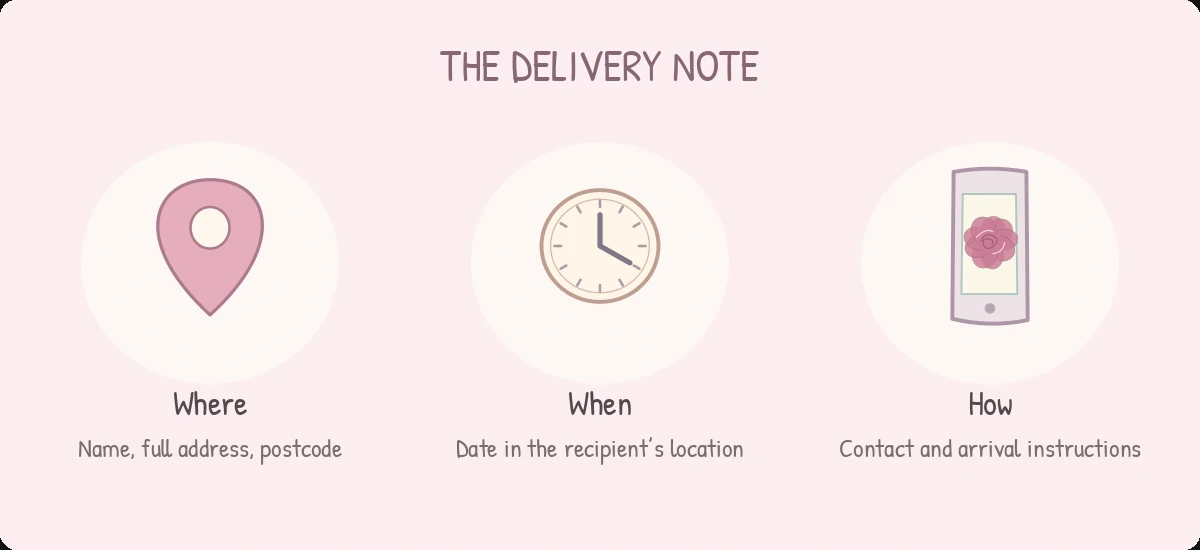
Give the florist a usable address
Ask the recipient or a trusted local contact to supply the address in the format normally used there. Preserve building names, accents and local-script details where the order form supports them. Do not translate a street name into an English description that the driver may not recognise.
- Full delivery address: include the recipient's name, building or house number, street, apartment or unit, locality, postal code where used, and country.
- Working phone number: use the format requested by the seller, including the country code where needed. Keep your own number in the sender field.
- Access instructions: give the entry or reception details needed for this delivery, without adding unrelated personal information.
- Recipient's local date: repeat it in a written enquiry if you need the florist to confirm an unusual arrangement.
For an office, give the company name and check when someone can accept the flowers. For a hotel, confirm that reception accepts deliveries, whose booking name it needs and whether the recipient will still be staying there. Ask a hospital ward directly whether flowers are permitted before ordering; acceptance at a main reception desk does not settle the ward's policy.
Decide what should happen if nobody answers. Ask whether the florist will call, use an agreed reception point or arrange another attempt, and whether an extra charge might apply. Do not authorise an unspecified outdoor safe place if you would be unhappy with flowers being left there.
A surprise works best when it does not depend on an impossible handover. If necessary, ask a simple question such as, “Will someone be home on Thursday?” without revealing the gift. Check whether delivery calls or tracking messages will go to the recipient.
Choose a design the destination florist can make
Shop from the destination catalogue, not from a domestic bouquet page you hope can be copied abroad. Ask about availability if a particular flower is essential. The fact that you can buy it at home is not confirmation that the receiving florist can obtain it for your date.
A useful brief separates the overall look from the non-negotiable detail. For example: “A compact arrangement in a vase, mainly yellow and white. Seasonal flower substitutions are fine, but please contact me before changing the colour palette or leaving out the vase.” This gives the florist room to work without making every change acceptable.
Read the substitution policy before relying on that message. Some sellers reserve the right to make changes without contacting you. If a condition really matters, obtain explicit agreement rather than assuming an order note overrides the terms. Give a contact method you can monitor despite the time difference.
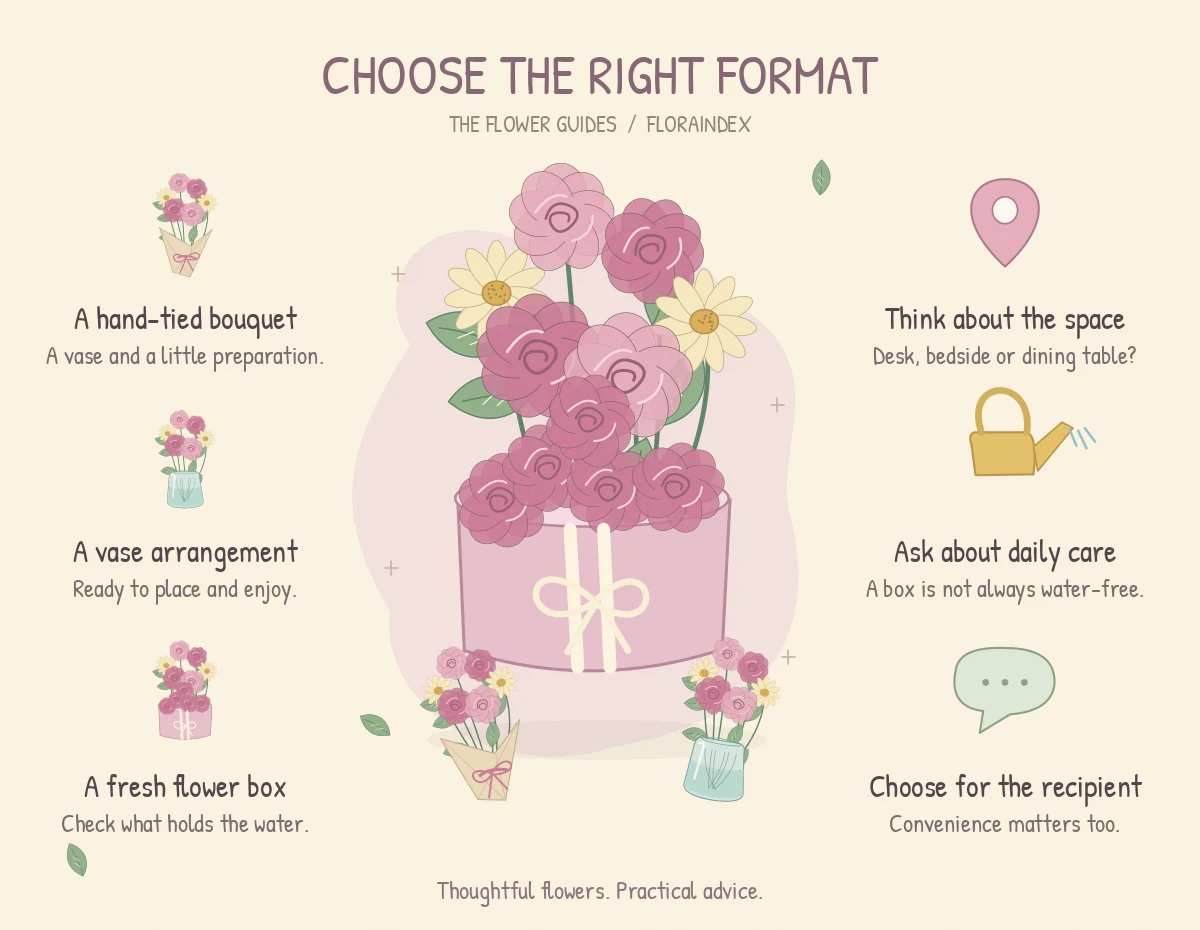
Think about what the recipient can do with the flowers on arrival. Someone staying in a hotel or recovering at home may appreciate a suitable container rather than stems that need arranging. Confirm that the pictured vase is included, its approximate size and whether the arrangement arrives ready to display. Our bouquet, vase or flower box guide compares those choices.
Let the recipient's preferences guide colour and style. If the flowers mark a culturally sensitive or formal occasion, ask someone close to them rather than relying on a universal colour chart or a country-wide etiquette rule.
Check the total and payment currency
Review the final amount after entering the delivery address, date, selected size and extras. Look for delivery or handling charges, taxes shown at checkout and any supplements attached to that location or day. A starting bouquet price is not a complete quote.
Confirm the currency in which you will be charged. A displayed estimate in your home currency may not be the transaction currency. If checkout offers a conversion, compare its terms with those from your card provider; ask the provider about any foreign-transaction charges rather than assuming a particular payment method is fee-free.
Keep the billing address separate from the delivery address. If an overseas card is rejected, contact the seller through its published support channel or choose another verified service. Do not email full card details or move to an unfamiliar payment link just to rescue the order. Check for an order confirmation or pending transaction before trying again, so you do not accidentally submit a duplicate.
Write a card that travels well
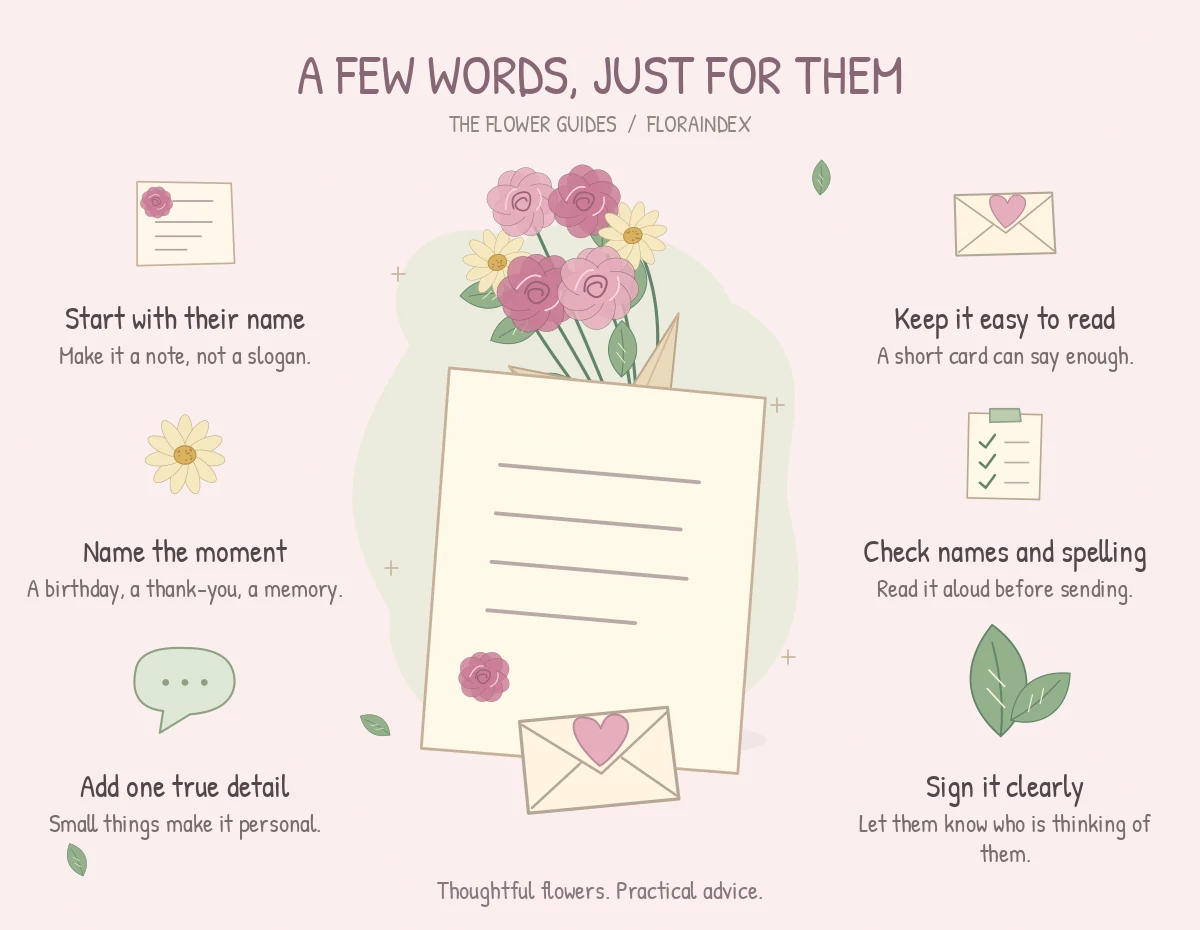
Sign the message clearly, especially if the sender's name will not otherwise appear with the flowers. A simple note such as “Happy birthday, Maya. Sending you a little sunshine from far away. Love, Sam” does not need an explanation of the delivery arrangements.
Preview the text after entering it. Check the seller's character limit, names, punctuation and whether it can print the script you want. For a message in a language you do not know well, have a fluent speaker check it. Keep private delivery instructions out of the card field and card wording out of the driver's notes.
An overseas order in practice
Imagine sending birthday flowers to a friend in a Toronto apartment while you are away in another country. They like bright flowers, have limited space and work outside the home. A large hand-tied bouquet delivered at an unspecified time is not necessarily the most useful choice.
First, get the complete apartment address and establish whether the building's reception can accept flowers. Then choose a florist serving that address and a compact vase arrangement in its available range. Explain that bright colours and the container matter more than specific stems. Ask whether delivery to reception on the birthday is available and how the friend will be notified.
Before paying, read back the order as a short checklist:
- The correct destination and birthday appear in the order summary.
- The apartment and reception instructions are complete.
- The selected size includes the vase, and substitutions fit the agreed brief.
- The final total and charge currency are clear.
- The card is signed, and both sender and recipient contact details are in the right fields.
- The seller has explained what happens if the first delivery attempt fails.
If reception cannot accept the flowers, change the plan before paying. A confirmed home-delivery day or another agreed address is more useful than a surprise that spends the birthday waiting for a handover.
Keep track without placing a second order
Save the product description, selected size, total, delivery terms and any written agreement about timing or substitutions. Keep the confirmation and order reference somewhere you can find them from your phone.
Read status messages literally. “Order received” may not mean a destination florist has accepted the job, and “dispatched” is not the same as delivered. If the seller's process leaves a gap, ask when confirmation is expected and which contact channel to use. Do not assume that silence means the order failed and immediately buy a replacement.
For a delivery to reception, a delivered status may refer to the handover there rather than to the recipient personally. Check with the agreed receiving point before reporting the flowers missing.
If the flowers are late, missing or wrong
Contact the business that took your order, using the order reference and the recipient's local date. Describe what happened: no delivery, a damaged arrangement, a missing vase or a change that contradicts the agreed brief. If appropriate, ask the recipient for photographs of the flowers, packaging and delivery label. Avoid sharing their address in a public review.
State what would still help. A later bouquet might suit one situation but be useless after a recipient has checked out of a hotel. Ask the seller to explain the available remedy and timing in writing. Do not assume that every international order carries the same refund entitlement or that a replacement will arrive that day.
If the seller does not resolve the problem, consult your payment provider and the relevant consumer-advice service promptly about options and deadlines. Those depend on the transaction and jurisdiction. Keeping the original order details makes the problem easier to explain without asking the recipient to manage the complaint for you.
Useful ordering references
- Interflora's Australia delivery page explains one example of destination-based florist fulfillment.
- Interflora's terms and conditions illustrate why international timing, substitutions and delivery arrangements need a seller-specific check.
- The US Federal Trade Commission's online shopping advice covers checking total costs, payment security and keeping order records; its legal guidance is US-specific.
A little more help
Occasions & messages
What to write on a flower card
Find words for celebrations, gratitude and difficult days, then make the message your own with a true detail and a clear signature.
Choosing flowers
Bouquet, vase arrangement or flower box: what should you send?
Choose the gift that fits the recipient’s space and daily routine, not just the product photograph. Compare what arrives, what needs watering and what the recipient must do next.