Occasions & messages
What to write on a flower card
Find words for celebrations, gratitude and difficult days, then make the message your own with a true detail and a clear signature.
On this page
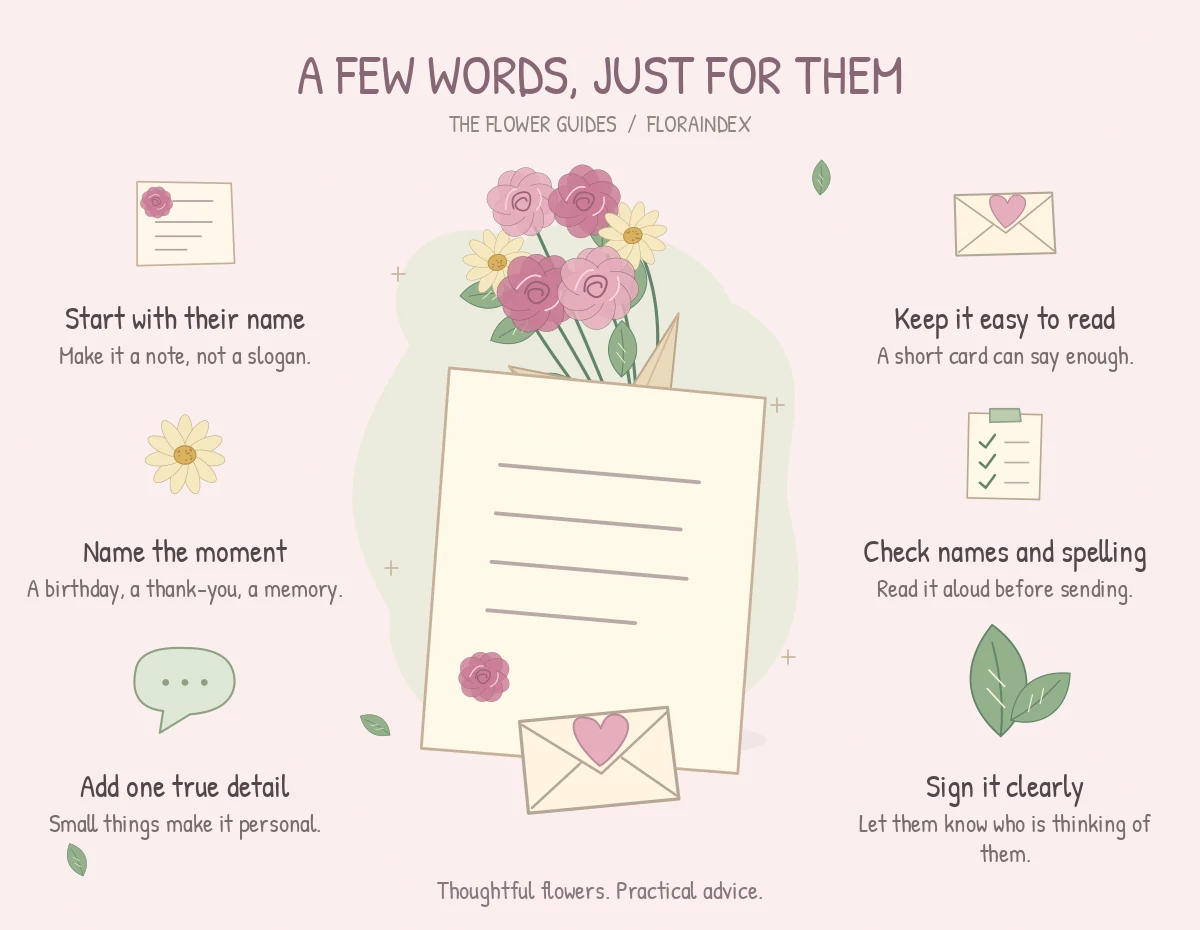
A flower card works best when it sounds like something you would actually say to the recipient. It can be affectionate, funny, restrained or very simple. It does not need a quotation, a rhyme or a grand declaration. Give the person a reason for the flowers, add something that belongs to your relationship, and make it clear who sent them.
Start with something true, not something impressive
Before writing, finish this sentence in your own words: “I am sending these because…” Perhaps your friend finished a difficult course, your aunt gave you a place to stay, or your partner has had a miserable week. That reason is more useful than trying to find a phrase that suits every bouquet.
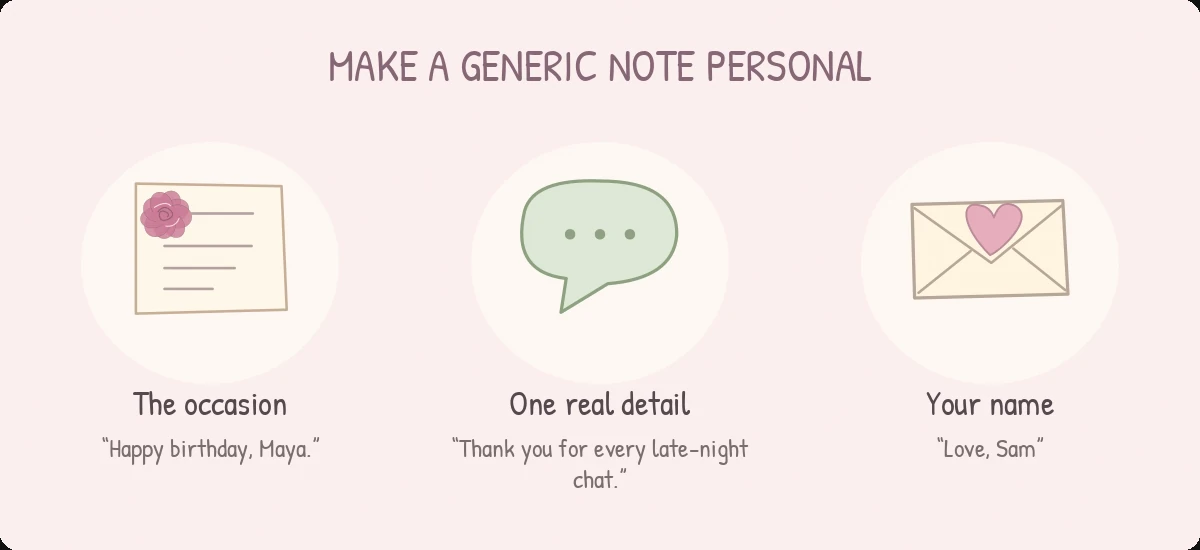
A reliable shape is name the occasion, add one personal detail, sign your name. You can leave out the occasion when there is none, or the personal detail when you do not know the recipient well. Do not fill the gap with a memory you did not share or an intimacy you do not have.
Congratulations on finishing your course, Maya. All those evenings at the kitchen table paid off. We are so proud of you. Love, Dad and Rose.
Use the examples below as starting points, changing names and details to fit your relationship. Keep the language you normally use. If “with fondest affection” would sound strange coming from you, “love” or “thinking of you” may be better.
Make a general message personal
Personalisation is usually a small edit, not an extra paragraph. Replace a broad compliment with the thing the person did, or a standard wish with something you know they are looking forward to.
Thank someone for the actual favour
Before:
Thank you for everything. You are wonderful.
After:
Thank you for taking the early train to help me move, Jules. The kitchen is finally unpacked. Dinner is on me next time. Love, Nina.
The revised version gives the recipient something recognisable. Keep the dinner offer only if you mean to follow through.
You can also keep that personal connection in a shorter message:
For getting me through moving day. Thank you, Jules. Love, Nina.
Give a birthday wish a familiar detail
Before:
Happy birthday. Have an amazing day.
After:
Happy birthday, Dad. Hoping your day includes a long walk, a second slice of cake and absolutely no DIY. Love, Mel.
Choose affectionate details, not a joke about something the person is sensitive about. A private family nickname also needs a little care if the flowers are going to work.
Turn praise into something specific
Before:
Well done on your achievement. You deserve it.
After:
You passed, Ravi! I remember when the first practice paper felt impossible. I am delighted for you. From your very proud sister, Anika.
Birthday cards for different relationships
Match the tone to the relationship rather than the size of the bouquet. A close friend may enjoy gentle teasing; a colleague may prefer a warm message without an age joke. Avoid guessing whether a milestone birthday is welcome news.
For a friend
Happy birthday, Frankie. Flowers now, our usual corner table on Friday. I cannot wait to celebrate with you. Love, Alex.
For a parent or grandparent
Happy birthday, Gran. These are for the spot by your favourite chair. Sending lots of love until we can visit. Tessa and Leo.
For someone you know less closely
Happy birthday, Denise. Wishing you a lovely day and plenty to look forward to this year. Warm wishes, Omar and Beth.
If you missed the date, acknowledge it without making the recipient manage your guilt:
A late birthday bouquet, but just as much love. I hope the celebrations were lovely. Jamie.
For a difficult birthday, a quiet “Thinking of you today” may fit better than insisting on celebration.
Love, anniversaries and flowers for no particular reason
Romantic wording does not have to be elaborate. An ordinary detail can say more than a borrowed declaration. For a new relationship, stay at the level of affection you have actually reached; the card need not make a public announcement on your behalf.
For an anniversary
Happy anniversary, Em. I still look forward to hearing your key in the door. Here is to more ordinary evenings together. All my love, Kit.
For someone you have recently started seeing
I have loved getting to know you, Sofia. These made me think of the garden we walked through on Sunday. Looking forward to next time. Max.
Just because
No occasion, Jo. I just wanted something lovely waiting for you when you got home. Love, Ash.
Use humour if it is already part of your relationship, but save intimate jokes for a private message. If the recipient dislikes surprises or public attention, agree on a home delivery rather than using an office bouquet to make a statement.
Thank-you cards that say what you appreciated
A useful thank-you names the act and, where space allows, its effect. “You made the new job feel less daunting” is more informative than “Thanks for being amazing.” Keep the emphasis on appreciation, not on how much the flowers cost or whether you now consider a favour repaid.
For a host
Thank you for such a relaxed weekend, Clara. It was lovely to sit around your table with no train to rush for. With love, Morgan and Lee.
For a colleague
Thank you for patiently showing me the ropes, Dev. Your notes made my first week much easier. With appreciation, Erin.
For a teacher
Thank you for all the encouragement this term, Ms Ellis. Noah comes home excited to tell us what he has learnt. Best wishes, the Reed family.
For a professional relationship, keep praise about the work or help given, and check any relevant gift policy before ordering. Do not sign on behalf of a whole team unless the team has agreed to the gift and message.
New beginnings and good news
Celebrate the news the recipient has actually shared. Avoid revealing a pregnancy, a new role or a move before they are ready to tell other people. Not every achievement needs advice about the next step: let a graduation be a graduation rather than a prompt to find a job.
For a new baby or a child's arrival
Welcome, little Ellis. Sending love to you, Mara and Tom as you get to know each other. No need to reply. From Auntie June.
Check names, spellings and the terms the family uses. Leave out assumptions about birth, feeding, siblings or future children. Address all the people you mean to include, without guessing at family roles.
For a new home
For your first bunch of flowers in the new place, Yasmin. Wishing you happy evenings and a quick reunion with the missing kettle. Love, Rob.
For a promotion
Congratulations on the new role, Elena. It is lovely to see your careful work recognised. Enjoy the celebration. Warm wishes, Chris.
For an engagement or wedding, address both partners by the names they use. A simple shared wish is enough; do not presume a name change, children or a particular household arrangement.
To Alex and Cameron, congratulations on your marriage. Wishing you a home full of good conversation and people you love. With affection, Rowan.
Illness, loss and difficult days
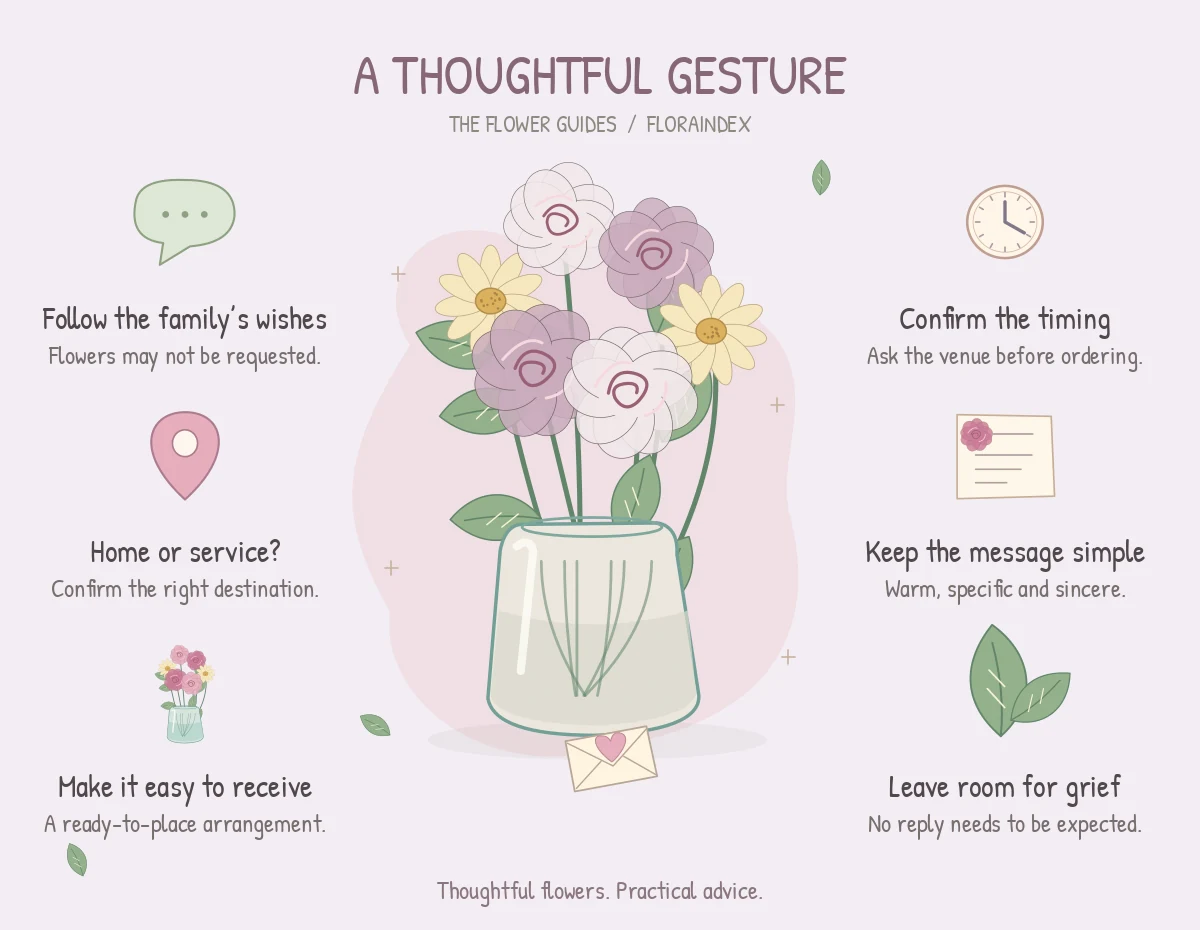
In a difficult situation, a card can offer company without requiring an update. Before sending flowers to a hospital or care setting, check with that setting and the recipient that the delivery is welcome. Keep diagnoses and treatment details off the enclosure.
During illness or recovery
Thinking of you, Rosa. I hope these bring a little colour to your room. There is no need to send an update; I am just sending love. Mae.
“Get well soon” may suit a short illness, but not every condition has a quick recovery. Avoid promising that everything will be fine, instructing someone to stay positive or suggesting that determination controls the outcome.
After a bereavement
Dear Luis, I am so sorry about Ana. I remember her warm welcome when we first became neighbours. Thinking of you and your family. With sympathy, Rachel Chen.
Use a memory only if it is yours. If you did not know the person who died, acknowledge the loss without inventing a connection. Leave out explanations, comparisons and phrases beginning “at least”. For arrangements, delivery decisions and more examples, see sympathy flowers and messages.
When there is no neat description for the situation
For your kitchen table, Kim. You do not have to put a brave face on with me. Sending love, and happy to listen whenever we next talk. Jess.
Only make offers you can keep. A specific, manageable offer can be helpful, but the recipient should remain free to decline it. Flowers do not entitle the sender to a reply, a visit or an explanation.
An apology needs more than flowers
If flowers are welcome, the card can accompany an apology, but it should not replace taking responsibility. Name what you did without blaming the recipient's reaction. Avoid “sorry if you were upset”, explanations that turn into excuses, and requests for immediate forgiveness.
I am sorry I spoke over you at dinner, Nadia. It was disrespectful, and I should have listened. I understand if you need some space. Theo.
Do not use a delivery to get around a request for no contact. If you are unsure whether flowers would feel kind or intrusive, leave the gift out. A bouquet is not a way to buy access to a conversation.
Sign the card clearly
Choose a closing that fits: “Love” for an affectionate relationship, “With appreciation” for thanks, or “Warm wishes” when you want friendly but not intimate. “From” is perfectly adequate. You do not need a formal closing as well as a long message.
Use enough of your name to be recognisable. “Sam” may work for your partner; “Sam Patel, from the allotment” may help someone who knows several Sams. For a group, use an agreed group name or the actual contributors' names. Ask whether the florist can include a separate note if the list will not fit.
Do not assume the purchaser's name will automatically appear on the card. Write the signature into the message field and check the order summary. Anonymous flowers can create uncertainty, especially in a new relationship or at work, so name yourself.
Protect privacy, then make the message fit
A florist may print or handwrite the card, and it may be handled or seen by someone accepting the delivery. Keep secrets, financial information, medical details and intimate disclosures for a private conversation. Even a message tucked into an envelope should not be treated as a secure channel.
Keep delivery instructions separate from the words you want on the card. “Please use the side door” belongs in the delivery notes, not after “Happy anniversary”. Check which name is the recipient's, which is the sender's and where the courier contact information goes.
Card sizes and message limits vary. Check the florist's stated limit rather than assuming every example will fit. If you need to shorten a message, remove repeated wishes and formal openings before cutting the name or the specific detail. Put a longer letter in a separate message, not a tiny block of text.
Finally, read it aloud. Check the recipient's name, the occasion, any shared details and the signature. Remove leftover template names and promises you cannot keep. If an ordering form changes punctuation or line breaks, preview what you can and ask the florist about anything important that is unclear. A plain, accurate sentence is better than an elaborate message that no longer sounds like you.
Further reading
A little more help
Choosing flowers
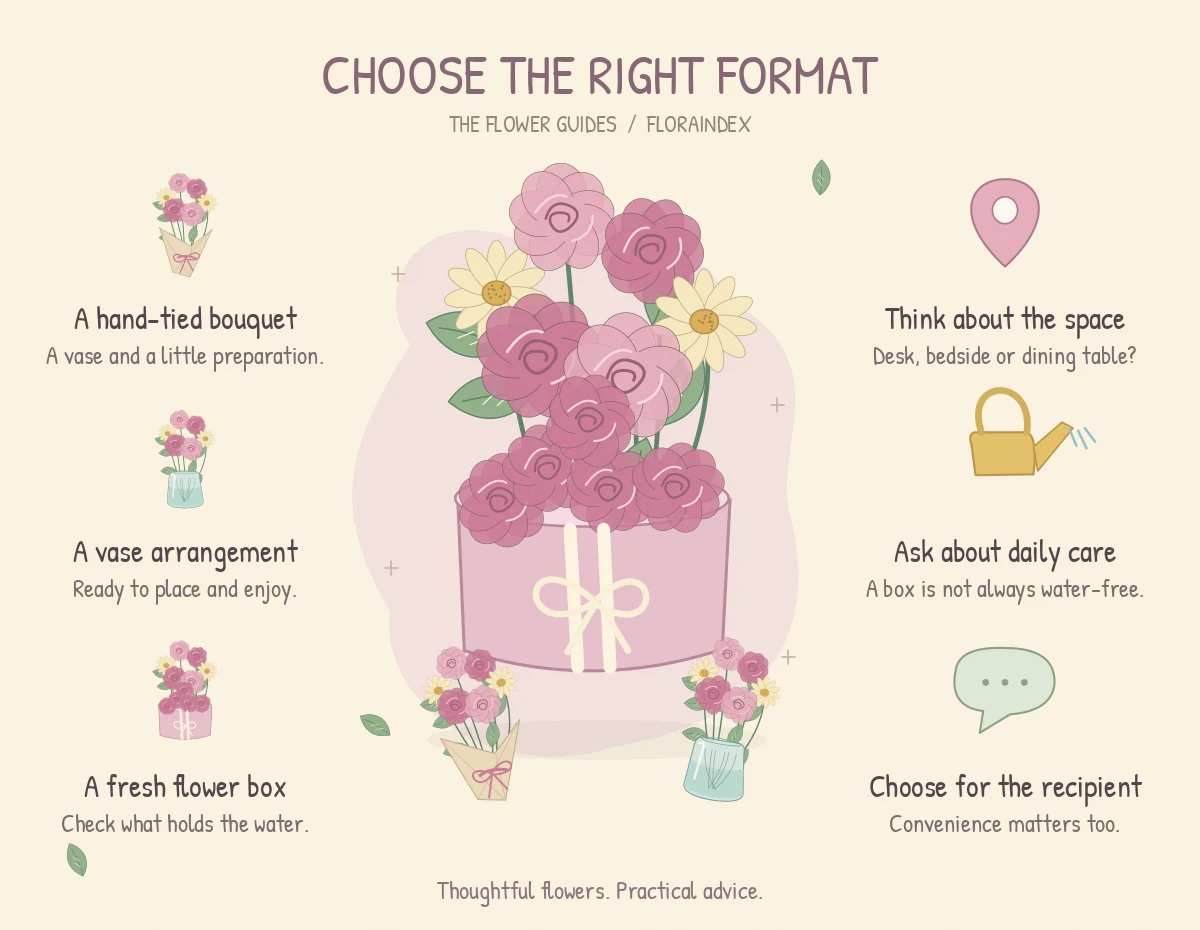
Bouquet, vase arrangement or flower box: what should you send?
Choose the gift that fits the recipient’s space and daily routine, not just the product photograph. Compare what arrives, what needs watering and what the recipient must do next.
Occasions & messages
Sympathy flowers: choosing an arrangement and writing the card
A practical guide to sending a considerate floral tribute, from honouring no-flowers requests to choosing the right delivery address and writing a personal note.