Occasions & messages
Sympathy flowers: choosing an arrangement and writing the card
A practical guide to sending a considerate floral tribute, from honouring no-flowers requests to choosing the right delivery address and writing a personal note.
On this page
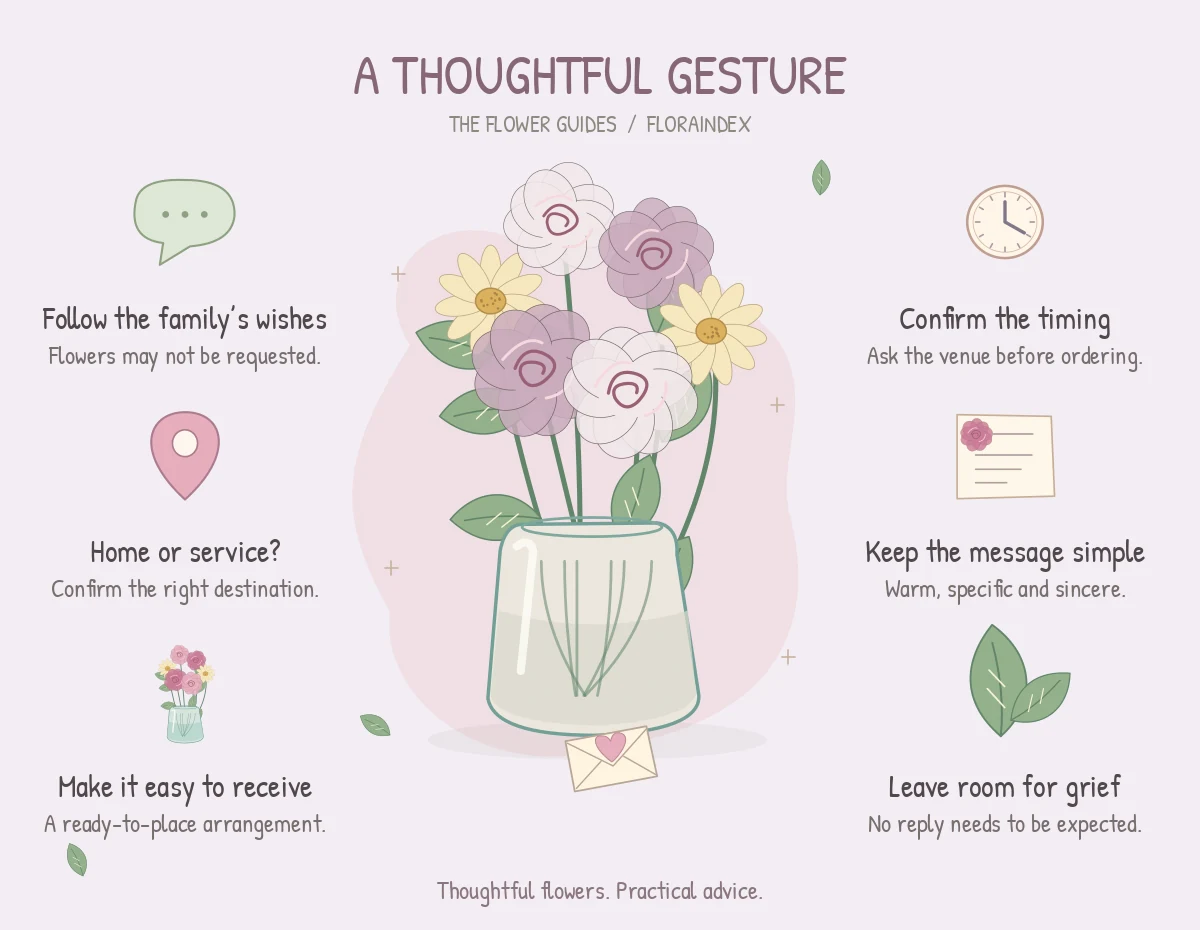
When someone dies, even a small decision such as choosing flowers can feel difficult. You may be unsure where to send them, what looks appropriate or how to write a card without sounding distant. Start with the family's wishes, then think about where the flowers will go. The arrangement does not have to speak for you: a few honest words can do that.
Check the family's wishes before choosing flowers
Read the funeral notice or the information shared by the family. “No flowers,” “family flowers only” and a request for donations are instructions to respect, not obstacles to work around. If donations are requested instead of flowers, use the named charity or fund through its verified channel. Do not assume that sending flowers to the house gets around a request not to send them.
If you cannot contribute, a thoughtful note is still a complete expression of sympathy. There is no need to explain your budget or buy a larger arrangement to prove how much the person mattered. With a group gift, make contributions optional and avoid attaching individual amounts to the message.
When the notice is unclear, ask the funeral director or the person coordinating arrangements whether flowers are welcome and where they should go. Family customs and preferences matter more than a general chart of religious or national traditions. Do not infer them from a surname, the venue or the flowers you have seen at another funeral.
Decide whether you are sending to the home or the service
For the home
A home delivery is addressed to the living person or household you want to support. It might arrive before the funeral, afterwards or when you learn about the death later. Choose something that fits an ordinary table and does not require the recipient to find a large vase or rearrange the room.
Check that someone can receive it. The family may be away, staying with relatives or spending much of the day elsewhere. If a mutual friend is coordinating practical help, they may be able to check this without adding another question for the bereaved person. Do not send to a workplace unless you know the recipient would welcome that visibility.
For a funeral or memorial service
A service tribute needs to fit a particular event. Confirm the deceased person's full name, the correct venue, the service date and the venue's accepted delivery window. A funeral home's office, a chapel and a cemetery are not interchangeable delivery addresses.
Ask the florist to confirm whether delivery can be arranged within that window. A general delivery date is not enough for an arrangement needed before a service. If the timing cannot be confirmed, a later home delivery, where welcome, is preferable to sending a tribute to a venue after everyone has left.
Choose the format before the flower varieties
Florists use some product names differently, so ask what actually arrives: loose stems, a finished arrangement in water, a supported design or a display with its own stand. Our guide to bouquets, vase arrangements and flower boxes explains the everyday formats in more detail.
- A compact vase arrangement: a practical option for a home if the recipient has space for it. Ask for manageable dimensions and check that the vase is included. Ready-arranged does not mean maintenance-free, but it avoids the immediate task of finding a container.
- A wrapped bouquet: suitable when you know the household welcomes flowers and has a vase. Check whether any travel water or packaging needs removing and whether clear care instructions accompany it.
- A low bowl or basket arrangement: an alternative for a table or an agreed display area. Check its size, how the stems are held and how it should be watered. A decorative outer basket is not necessarily the water container.
- A wreath or standing spray: a tribute designed for display rather than an everyday tabletop gift. Confirm the venue accepts it and whether the required stand or support is included. Do not select a religious shape unless you know it is wanted.
- A coffin or casket arrangement: coordinate this with the people arranging the funeral. It forms part of their plans and should not arrive as an unsolicited duplicate.
A living plant creates an ongoing care task. Choose one only if that is a gift the recipient would enjoy, rather than treating it as an automatically easier substitute. For any large service arrangement, check whether the organisers have plans for it afterwards; do not assume the family can transport it home.
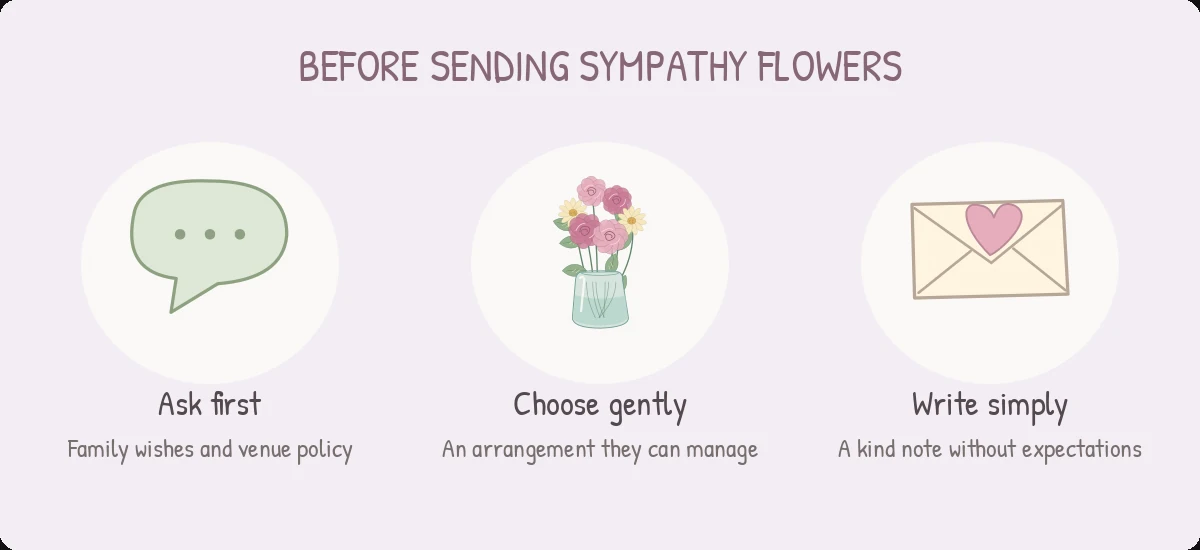
Let personal preferences guide colour and size
White and soft colours are available choices, not a rule for expressing grief. If the family welcomes flowers and you know the person loved orange roses or a colourful garden, ask whether that preference can guide the arrangement. You do not need to assign a symbolic meaning to every stem.
If you do not know their taste, describe the setting and the feeling you want: a modest arrangement for a small flat, for example, or a simple tribute for a service. Give the florist your total budget and ask what it covers, including the container, delivery and any stand. Avoid judging suitability by size alone.
Tell the florist about any known dislikes or scent sensitivities. If a particular colour or flower has personal importance, say so before paying and discuss substitutions. “Yellow was her favourite colour; the variety can change” gives a different instruction from “the roses must be yellow.” Neither detail should depend on an assumption about what the florist will infer from a photograph.
Write to the person you are supporting
For a home delivery, address the person or household receiving the flowers. For a service tribute, a brief message in memory of the person who died can work, but remember that the family will read it too. If you knew a colleague but never met their parent, write to your colleague; you do not need to pretend you knew the parent.
A useful starting point is acknowledge the death, add one true thought, then sign clearly. The middle part is optional. It could be a small memory, an expression of affection or a specific offer of help you can genuinely keep. A short card is not a test of eloquence, and a longer letter can follow separately.
Adapt the messages below to your relationship. Keep only what is true, and use the name or family term the recipient normally uses.
For a close friend after a parent's death
Leah, I am so sorry about your dad. I will remember how he made space for everyone at your kitchen table. Sending you and your family my love. Priya.
When you did not know the person who died
Marcus, I was sorry to hear about your sister. I am thinking of you and everyone who loved her. With sympathy, Helen Brooks.
For a tribute at the service
In memory of Daniel, whose quiet kindness meant so much to our street. With affection from the neighbours on Willow Lane.
From colleagues
Aisha, we are thinking of you and your family after the death of your mother. There is no need to reply. With warmest sympathy, the library team.
With an offer you can follow through on
Ben, I am so sorry about Ruth. I can walk Milo on Saturday if that would help. I will check in by text. With love, Ellie.
A practical offer belongs only where the relationship makes it welcome. Do not promise daily visits, unlimited availability or help that depends on somebody else's agreement. If you need to discuss dates or arrangements, do that privately rather than making the flower card carry the whole conversation.
Leave out explanations, comparisons and pressure
A sympathy message can acknowledge pain without trying to resolve it. Cruse Bereavement Support advises against guessing how somebody feels or promising support you cannot give. In a short card, restraint is especially helpful.
- Avoid sentences beginning “at least”. Pointing to age, other family members or an end to suffering can sound as though the bereaved person should feel less loss.
- Do not set a timetable. Leave out predictions about when life will feel normal, and instructions to stay strong or move on.
- Do not compare losses. Your own bereavement may help you listen, but the enclosure card is not the place to explain that you know exactly how they feel.
- Use religious language only when you know it fits. A shared prayer may be welcome; an assumption about an afterlife or a reason for the death may not be.
- Keep private circumstances private. Leave medical details, the manner of death and family disagreements off the card.
If your relationship with the family is complicated, keep the message simple and respectful. This is not the moment to seek reconciliation, ask why you were not contacted or make the recipient reassure you. If contact is unwelcome, do not use a florist to bypass that boundary.
Make the sender easy to identify
Sign with enough information for the family to recognise you. A first name may be enough for a close friend; a full name and connection can help when you knew the deceased through work or a club. For instance, “Nadia Evans, from the walking group” is clearer than an unfamiliar initial.
For a group arrangement, use a recognisable group name and, if needed, send a separate note listing contributors. Do not imply that everyone in a department contributed if they did not. Avoid anonymous sympathy flowers: uncertainty about the sender is an unnecessary puzzle.
A florist may print or handwrite your message, and people helping with deliveries may handle it. Treat it as personal but not confidential. Keep phone numbers in the delivery contact field, not in the condolence message, unless you deliberately want them on the card. Check names and spellings before submitting the order.
If you hear later, you can still acknowledge the death
You do not have to abandon a kind gesture because the funeral has passed. A home arrangement or note may be welcome later, subject to the same preferences about flowers. Address the loss without making a long apology for your timing.
Jo, I have only just heard about Peter. I am so sorry. I still think fondly of our afternoons at the allotment, and I am thinking of you now. With love, Sam.
Birthdays and anniversaries can also be occasions to check in, but a surprise memorial delivery is not automatically welcome. Let your knowledge of the person guide you, or ask gently. Continuing contact can be as ordinary as a message or an invitation with no pressure to accept; it does not have to involve another purchase.
Before you place the order
Keep the final check practical: are flowers welcome, is this the right address, will someone receive them, and has any service delivery window been confirmed? Re-read the card without the product photograph beside it. It should still make sense, identify the sender and ask nothing of the recipient.
If you need help finding someone to discuss the arrangement with, browse florists and ask directly about the venue and format. For more wording options, see what to write on a flower card. Once sent, do not chase the bereaved person for a photograph or a thank-you. Raise delivery questions with the florist.
Further reading
A little more help
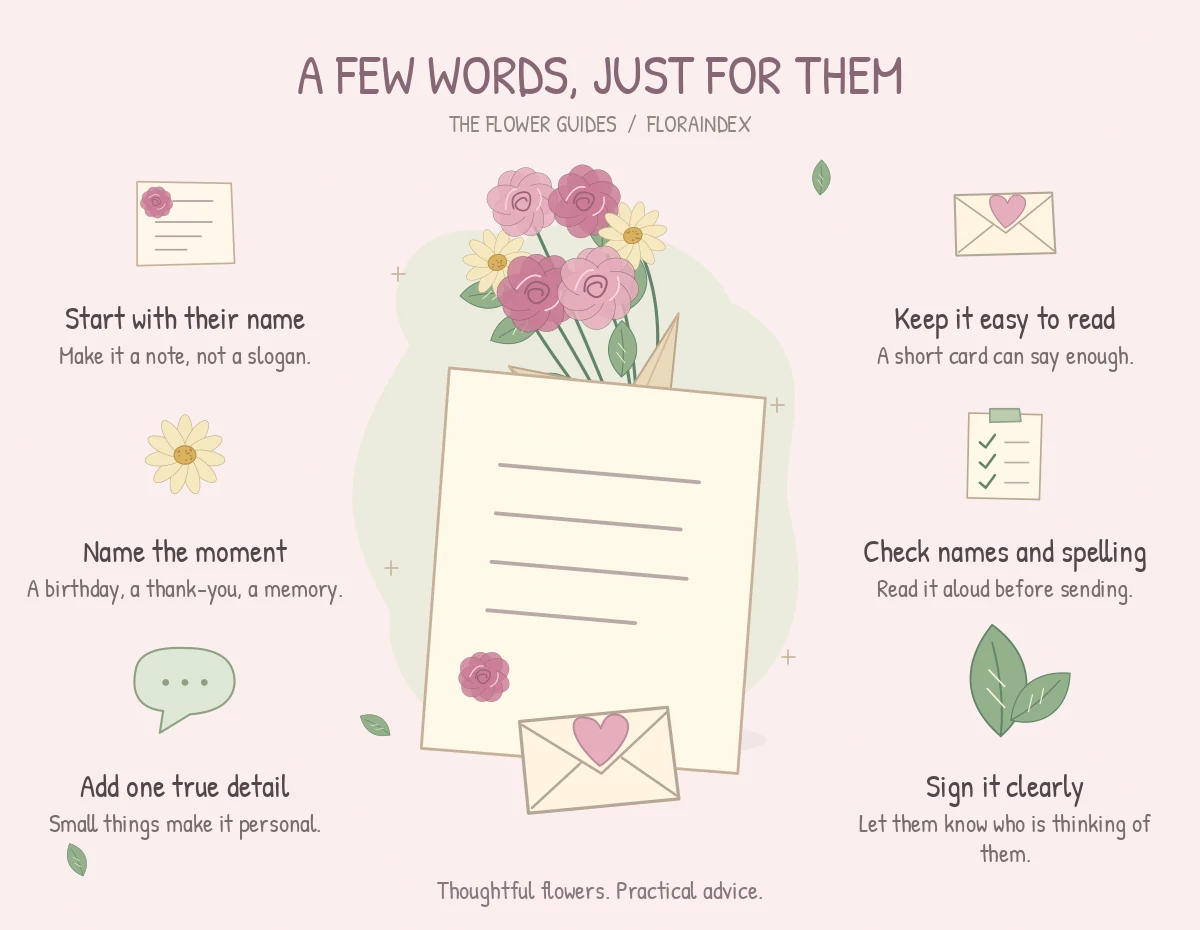
Occasions & messages
What to write on a flower card
Find words for celebrations, gratitude and difficult days, then make the message your own with a true detail and a clear signature.
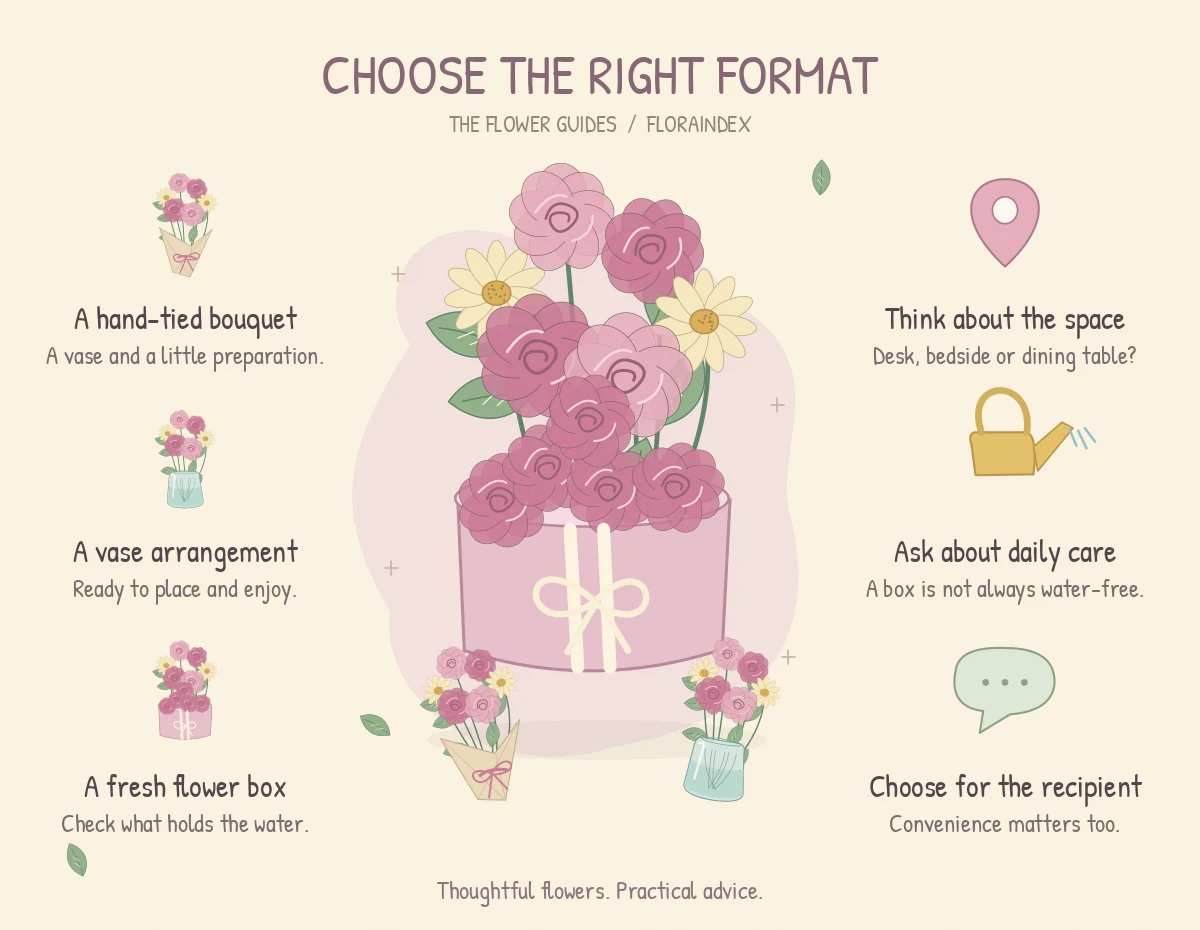
Choosing flowers
Bouquet, vase arrangement or flower box: what should you send?
Choose the gift that fits the recipient’s space and daily routine, not just the product photograph. Compare what arrives, what needs watering and what the recipient must do next.