Sending flowers
How to choose a reliable florist online
Judge the business behind the bouquet, not just its photographs or star rating. These checks help you compare the actual flowers, delivery promise and support you are buying.
On this page
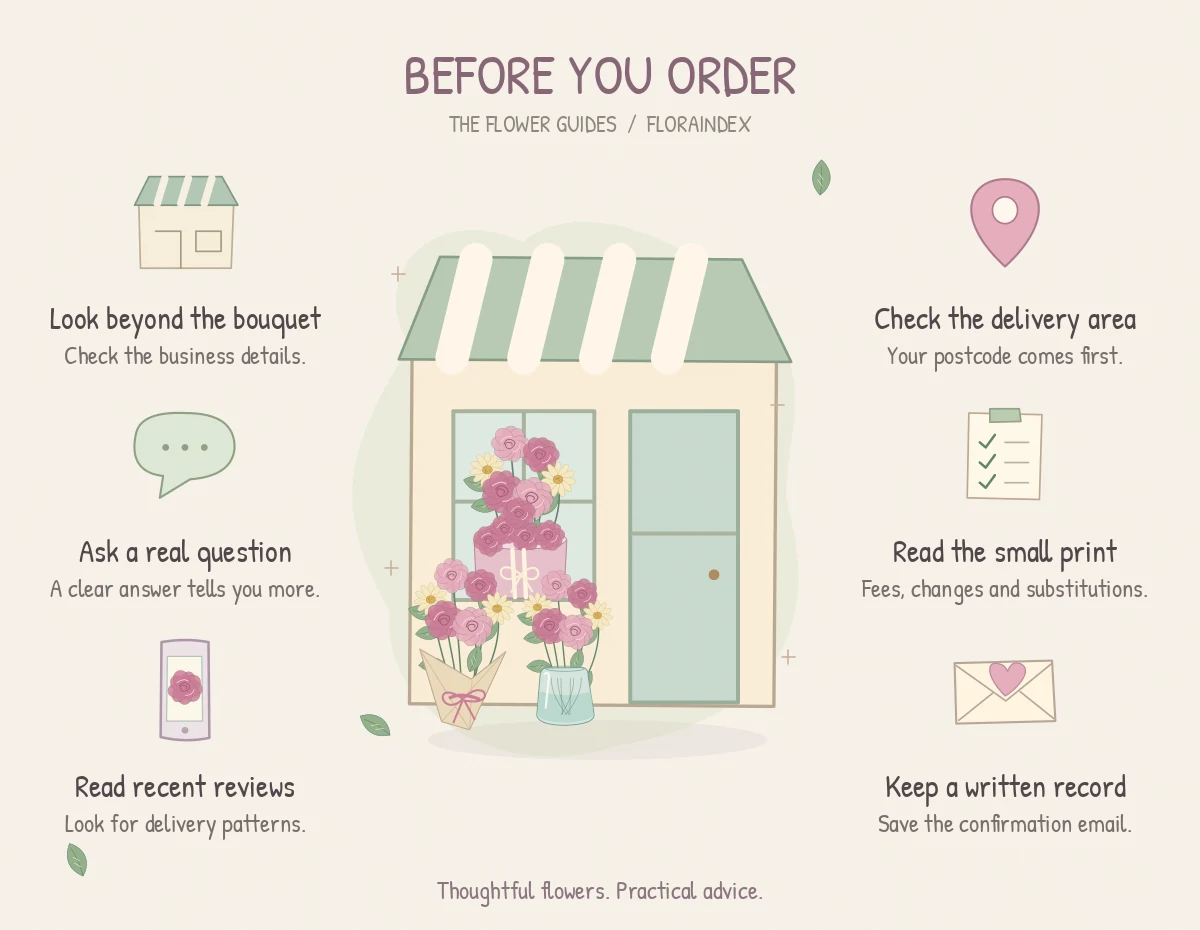
A beautiful bouquet photograph tells you what you like. It does not tell you who will make the arrangement, whether the pictured size is the one you are buying or what happens if the delivery goes wrong.
To choose a reliable florist online, look for a business you can identify, an offer you can understand and a sensible way to resolve problems. Reviews help, but they work best alongside those checks. You do not need to become an investigator; you need enough clear information to know what you are paying for.
Understand who will fill the order
A florist's own website, an order-taking network and a seller shipping boxed flowers can all appear in the same search results. They may suit different needs. Establish which kind of service you are considering before comparing bouquets.
For a florist preparing its own arrangements, look for its delivery area and examples of the kind of work you want. With a network, ask who will prepare the flowers and whether central customer support or the delivering florist handles changes. For a parcel service, establish whether the recipient gets an arranged bouquet, loose stems or another format, and whether the arrival date is guaranteed or estimated.
Direct ordering is useful when you need to discuss a particular design. A network may simplify placing an order outside your area. A boxed delivery may suit someone who enjoys arranging flowers. The business model alone does not establish reliability, and a website calling itself local does not answer who will actually make your order.
Use the florist directory to discover candidates, then check the seller's own information. A prominent search position or paid placement is not evidence that one florist is better than another.
Look for a business you can identify
Compare the business name, contact details and delivery area across the website's contact page, terms and checkout. A trading name can differ from a legal company name, but the relationship should be explained rather than left for you to guess. Notice whether the order confirmation will come from the same business.
An address helps you understand who you are dealing with, but read what kind of address it is. A registered office is not necessarily a flower shop. A studio may operate without a walk-in retail counter. The useful question is whether the business describes itself consistently, not whether every legitimate florist has the same premises.
Look for a workable contact route and stated service hours. If your order is time-sensitive, test that route before buying with a question that matters to the purchase. A reply explaining delivery limits is more useful than an instant automated greeting.
If the site displays an association badge or award, follow it to the issuing organisation where possible. Check what it actually recognises and whether it applies to this business. Do not treat a decorative logo or a claim to be “award-winning” as proof of delivery reliability.
A quiet social media account or a plain website is not a reason to reject a florist on its own. More serious concerns are contradictory identities, no usable support contact, unexplained payment recipients or an inability to say whether the address is served. Pause until those are resolved.
Compare the bouquet, not just the photograph
Read the product description beside the image. A close crop can make a small arrangement look generous; a photograph may show an upgrade while the starting price selects a smaller version. Neither is automatically misleading if the seller explains it, but the distinction should be visible before you pay.
- Selected size: check which version is pictured and what changes between the options. Useful details include dimensions, stated stem counts or an explanation of the design difference.
- Vase included? establish whether the container is part of the purchase, an optional extra or a styling prop.
- Arrival format: find out whether the flowers arrive arranged, wrapped for transfer to a vase or boxed for the recipient to arrange.
- Substitution policy: read which flowers, colours or containers may change and whether you will be contacted first.
Compare like with like. A compact vase arrangement and a loose bouquet with more stems are different purchases, not a simple contest in quantity. Branching stems and large flower heads also make stem counts a poor standalone measure of visual size. If space matters, ask for approximate height and width rather than guessing from the photograph.
Look for work relevant to your order. An impressive wedding portfolio does not show precisely what a routine birthday delivery includes. A varied gallery or customer photograph can help set expectations, but no image proves that your own bouquet will match it exactly.
For a “florist's choice” design, establish the boundaries: colour palette, approximate size, container and anything the recipient dislikes. Creative freedom is easier to accept when you know what remains fixed. If you are unsure which format would suit them, compare bouquets, vase arrangements and flower boxes before choosing a seller's product.
Read reviews for patterns, not just stars
Open more than the testimonials selected for the florist's homepage. Read recent reviews from more than one source, including a mix of positive, middling and negative experiences. The US Federal Trade Commission advises looking beyond star ratings and warns that reviews can be fake or manipulated in either direction.
Match the review to the service you need. Comments about an in-store purchase say less about delivery coordination than an account of an order reaching a workplace. A complaint about a courier-delivered box may not describe the seller's hand-delivered arrangements. Check the branch or location too.
Look for repeated, specific issues: missing items, unclear size upgrades, missed agreed dates or unanswered complaints. One disappointed customer is not proof of a bad business. Repeated descriptions of the same unresolved problem deserve more attention than a single angry sentence.
Read the responses. Does the business acknowledge the reported issue, explain a next step and move personal details to a private channel? A polite response does not prove the complaint was resolved, but it shows more than a pasted promotional reply. Equally, a seller should not have to publish a customer's private order details to defend itself.
Sudden clusters of reviews, repeated wording or vague praise are reasons to cross-check, not grounds for declaring fraud. As the FTC notes, it can be nearly impossible to identify fake reviews just by looking. Treat “verified purchase” labels as one piece of context, and do not give an unexplained rating badge more weight than the underlying reviews.
Ask a question that tests the service
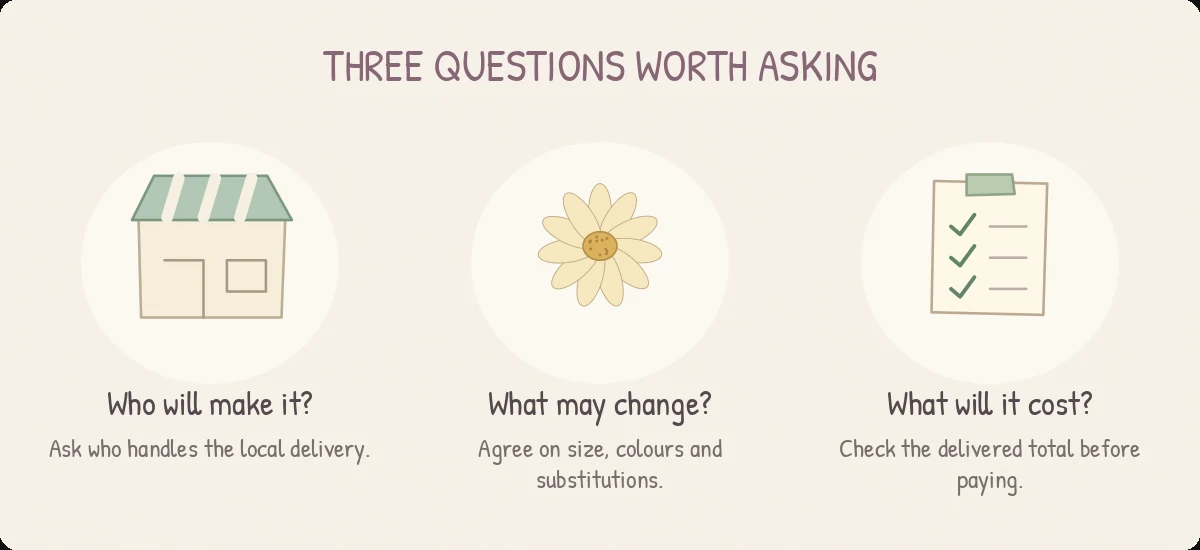
If the order has a condition you cannot compromise on, ask about it before paying. A useful enquiry might be:
I'm considering the medium yellow-and-white vase arrangement for an office delivery. Is the pictured vase included at that size? If those colours are unavailable, will you contact me before making the order? Reception closes in the afternoon; can you confirm whether your service is suitable?
This tests product knowledge and delivery fit without asking the florist to prove everything at once. A good answer might confirm the details, offer an alternative or say the timing cannot be promised. An honest refusal is preferable to a vague “no problem” that leaves the important condition unanswered.
Compare the reply with the published terms. Interflora's terms, for example, allow substitutions of equivalent value or quality in supply difficulties without notice, although contact may be made where possible. That is one seller's policy, not an industry-wide rule. It illustrates why “please call first” in an order note needs explicit agreement if it matters to you.
Save any agreed exception. If customer service promises something the checkout cannot record, ask for written confirmation linked to your order. Do not expect a special request to become a guarantee merely because the form accepted the text.
Read the full price and the problem policy
Compare the amount you would actually pay for the selected size, address and date. Include the container, delivery, service fees and other charges shown at checkout. Remove extras you do not want and check whether a delivery pass or subscription is optional. A lower starting price may buy a different product or exclude something included elsewhere.
Before committing, find the policy for an absent recipient, an incorrect address, damaged flowers and an order that fails to arrive. Look for how to contact support, what evidence it asks for and how promptly it wants a complaint raised. A freshness promise should explain its scope and available remedy, not just display a reassuring badge.
Separate a change of mind from a problem with the order. The EU's Your Europe guidance lists rapidly perishable goods among the exceptions to the usual 14-day cooling-off right. Do not assume you can cancel fresh flowers under the same rules as an ordinary non-perishable online purchase. That exception is also not a blanket answer to a complaint about faulty or undelivered goods; applicable rights need a jurisdiction-specific check.
For a date-critical gift, check what the seller means by a delivery date. An estimate, a requested date and a confirmed timed service are different promises. If the flowers would be useless after a particular time, say so before buying and keep the response.
Use a payment route you understand
Check the address of the checkout page, particularly if you reached the seller through an advertisement or social message. It should belong to the seller or a clearly identified payment provider. The FTC notes that HTTPS encrypts a connection but does not prove a website is legitimate; fraudulent sites can use it too.
Prefer a payment method with a documented process for purchase disputes. The FTC recommends credit cards in its US shopping guidance, but protections, eligibility and deadlines differ by country and provider. Read your own provider's terms rather than treating a familiar payment logo as a universal refund promise.
Be wary of pressure to abandon the checkout and pay an unfamiliar recipient by gift card, cryptocurrency or a money-transfer service. A bank transfer offered by an established local business is not automatically fraud, but understand what recourse you would have before choosing it. Never send full card details in an ordinary email or chat.
Choose between two plausible sellers
Suppose one website advertises a generous bouquet at an attractive starting price, but the pictured size is unclear, the vase costs extra and the delivery policy does not explain missed handovers. Another shows a smaller arrangement with dimensions, an included vase, a complete delivered price and clear contact details.
The second is easier to judge, but the first is not automatically dishonest. Ask it to clarify the gaps. If its answers resolve them, compare the actual offers. If the answers remain vague, the transparent offer is a more defensible choice even if its photograph looks less dramatic.
Use a short final check rather than inventing a score from star ratings:
- You know which business takes responsibility for the order.
- The selected arrangement, size and included items are clear.
- The service fits the address and any essential timing requirement.
- You understand substitutions and have written agreement on important exceptions.
- The complete price, contact route and complaint process are available before payment.
If an essential answer is still missing, keep looking. You do not need the florist with the slickest website; you need one whose actual offer suits this recipient and this occasion.
Keep the details after ordering
Save the confirmation, selected product description and any written promises. If something goes wrong, contact the seller promptly with the order reference and a clear description of the problem. Photographs can help with condition or missing-item complaints. Request a suitable remedy without assuming that every business or jurisdiction offers the same one.
When the recipient lives abroad, add the destination and time-zone checks in how to send flowers overseas. Choosing a credible seller answers who to trust with the order; those delivery checks establish whether the plan will work.
Consumer and ordering references
- FTC: Online shopping, including total costs, payment security and order records. Legal protections discussed there are US-specific.
- FTC: How to evaluate online reviews, including the limits of spotting manipulated reviews.
- Your Europe: Returns and the right of withdrawal, explaining EU cooling-off rules and exceptions.
- Interflora: Terms and conditions, a seller-specific example of substitution and complaint provisions, not a recommendation or universal standard.
A little more help
Choosing flowers
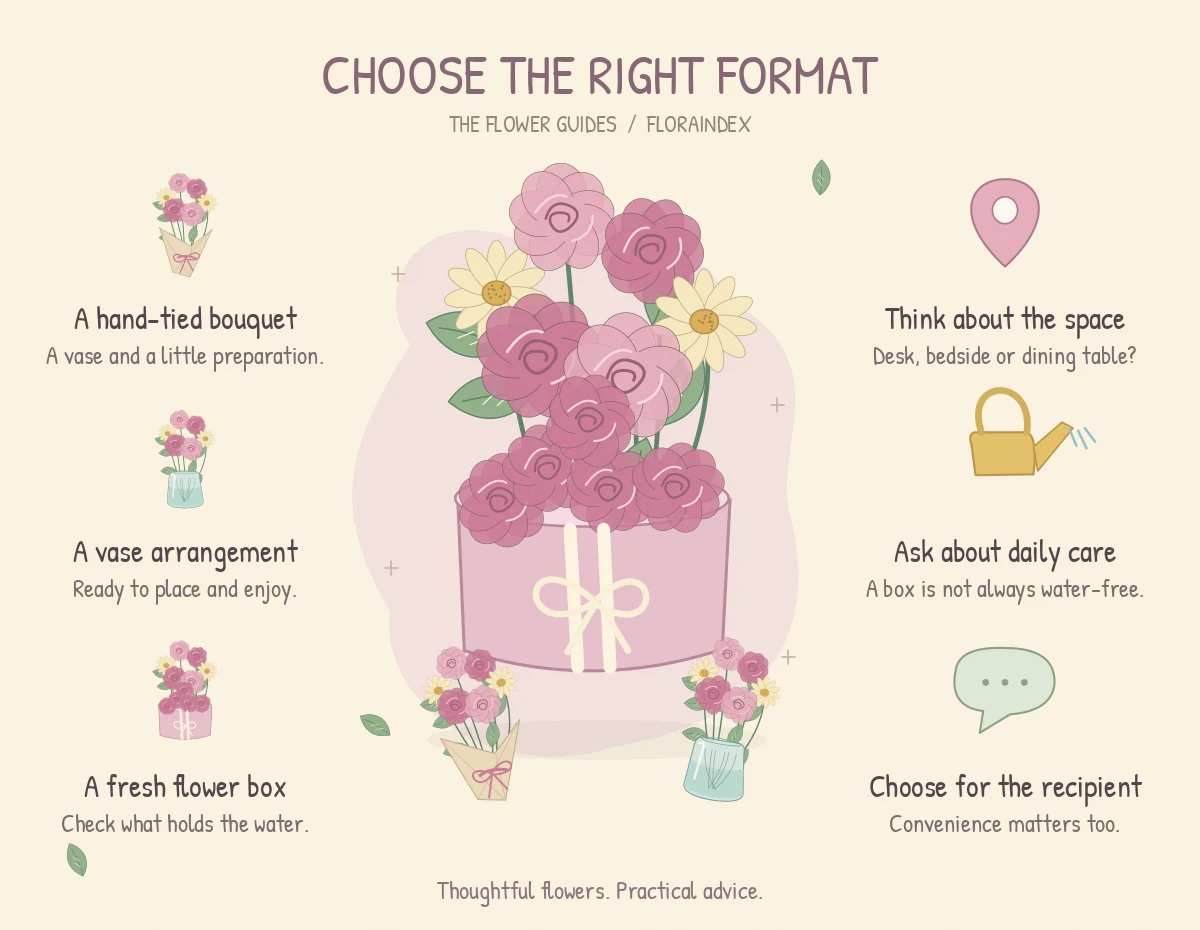
Bouquet, vase arrangement or flower box: what should you send?
Choose the gift that fits the recipient’s space and daily routine, not just the product photograph. Compare what arrives, what needs watering and what the recipient must do next.
Sending flowers
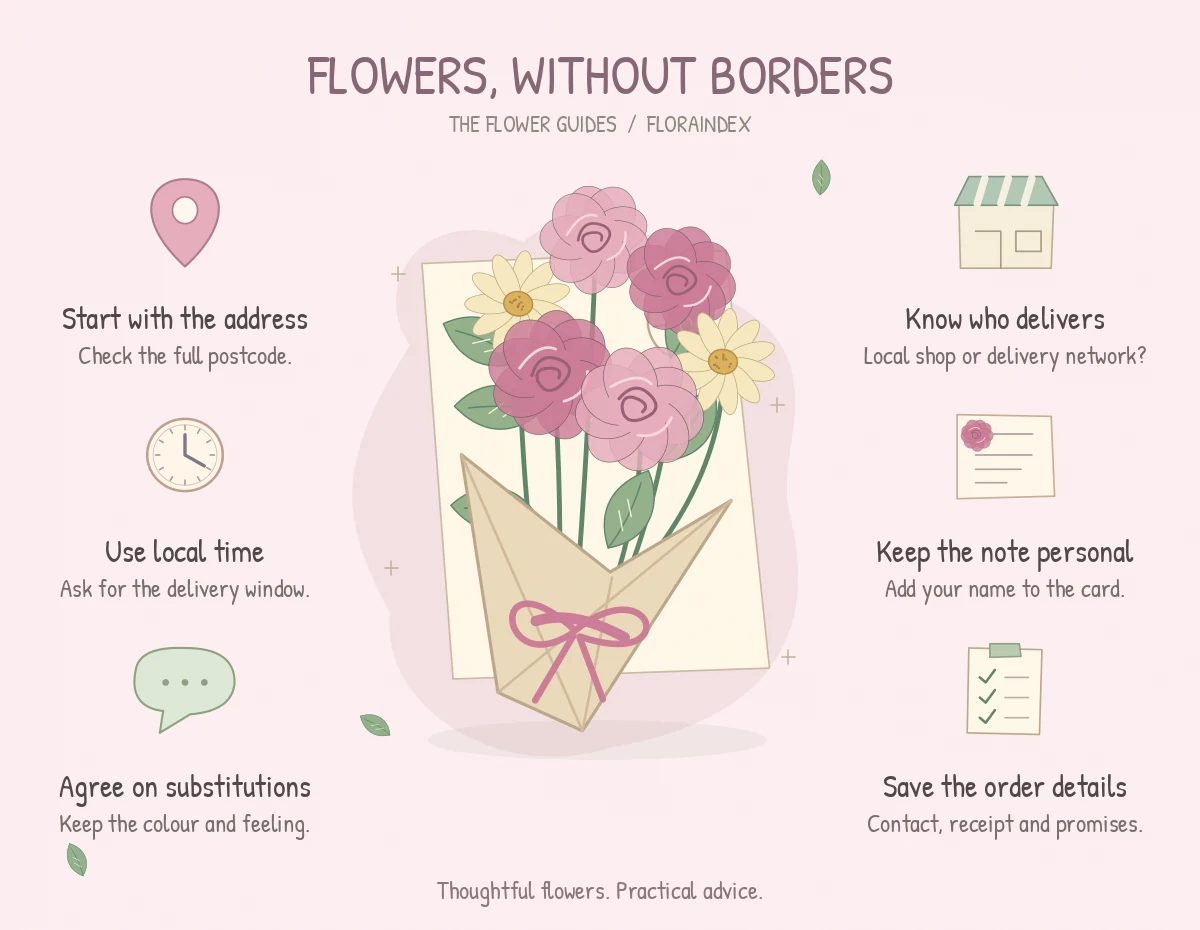
How to send flowers overseas
Arrange a flower delivery in another country without confusing local florist fulfillment with international shipping. Plan the date, handover and order details before you pay.